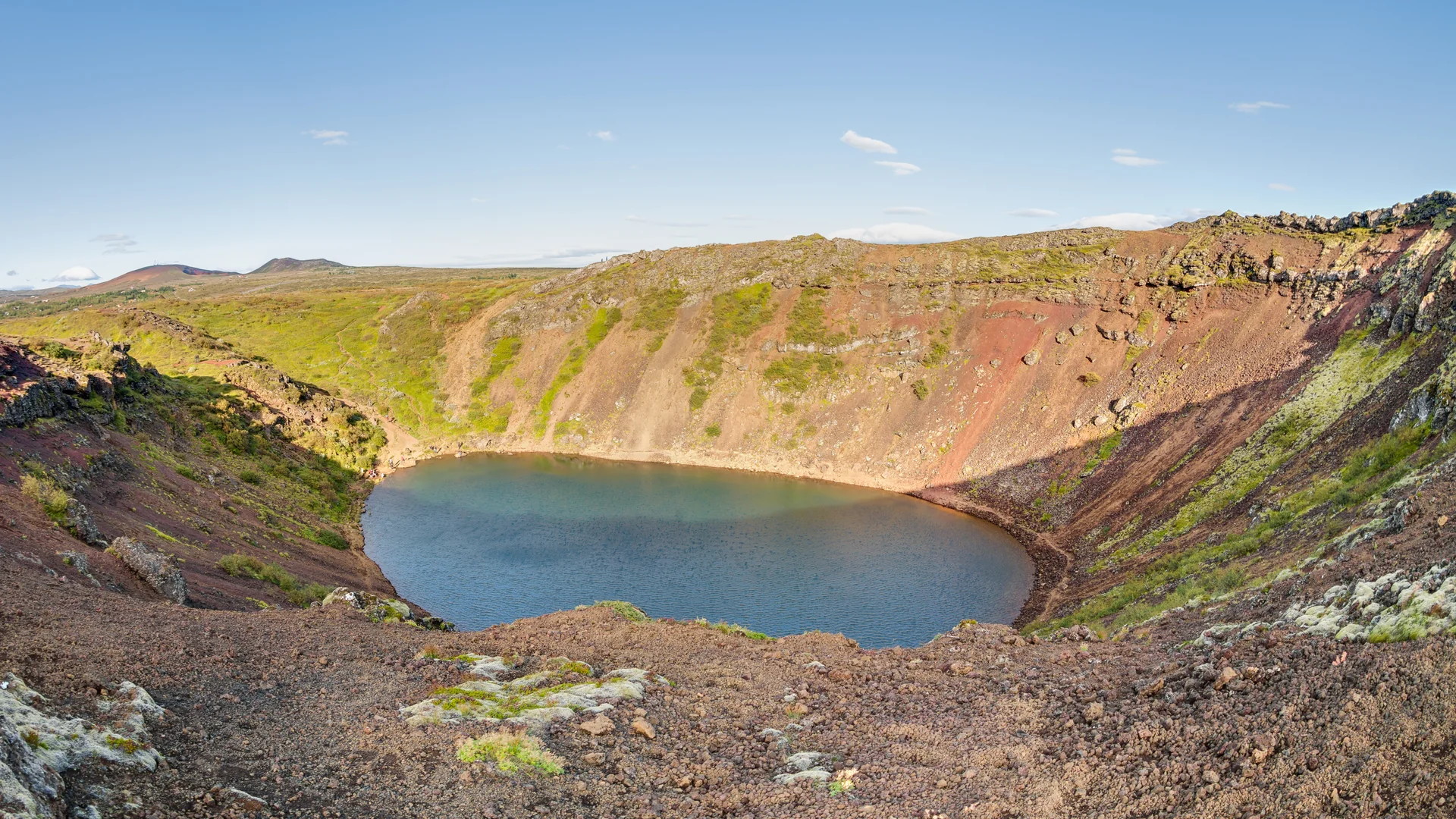
One of Iceland's youngest volcanic craters contains a geothermally influenced lake of vivid teal that occupies the crater floor, its depth and colour seeming impossible for its apparent size.
Kerið is not the largest crater in Iceland. It is not the most dramatic. It erupted approximately 6,500 years ago — recent by geological standards — and the eruption was not particularly catastrophic. What it left behind, however, is one of the most visually striking geological formations on Earth: a red volcanic caldera, 55 metres deep and 170 metres wide, with a teal lake at its bottom that shifts in colour through blues and greens depending on light, season, and algae content.
The crater walls are reddish-brown from oxidized iron in the volcanic rock — the same chemistry that gives Mars its colour — and the contrast with the vivid lake below is jarring in a way that photographs almost never capture accurately. The human eye keeps recalibrating, unable to settle on whether the lake colour is real.
The water level in the lake rises and falls with the surrounding water table rather than with rainfall — evidence that it connects to the groundwater system rather than relying on precipitation. Geothermal heating keeps it from freezing entirely in winter. Algae bloom in summer and intensify the green tones.
Björk recorded an orchestral concert on a floating stage in the crater in 2004. The acoustics, shaped by the amphitheatre walls, were reportedly extraordinary. The audience stood on the crater rim looking down at the performers floating on the teal water below — a performance venue created by an accident of volcanic geology 6,500 years before anyone thought to perform in it.
Safety information
Safety information is not available yet.
Before visiting this place, check current safety guidance, access rules, local restrictions, and official updates on other trusted websites. Our editorial team does not have verified safety information for this location at the moment; it will appear here later.