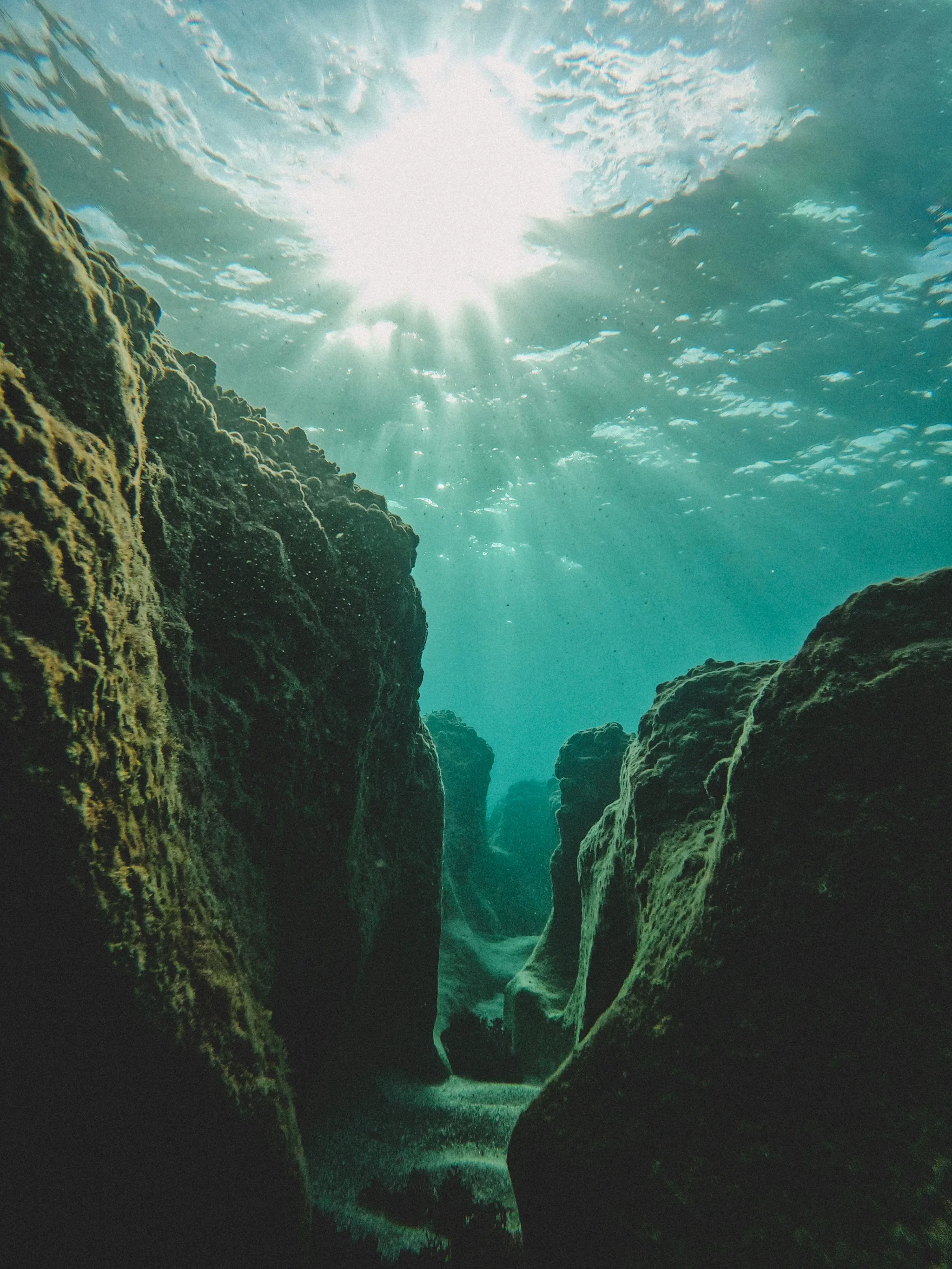
A massive underwater rock formation off Japan's westernmost island, featuring staircase-like terraces and impossibly sharp angles — the center of fierce debate between those who see natural stone and those who see a lost civilization.
Yonaguni-jima is the westernmost inhabited island in Japan — positioned approximately 100 kilometers from Taiwan's eastern coast, closer to Shanghai than to Tokyo. The island is small, roughly 29 square kilometers, with a population of about 1,700 people. For most of its modern history it was primarily known for its distinctive local awamori spirits, its cattle, and its position on the migratory route of hammerhead sharks that aggregate offshore each winter. In 1987, a local dive tour operator named Kihachiro Aratake was exploring the seafloor off the island's southeastern coast and found something that did not fit the surrounding geology.
The Yonaguni Monument is a massive formation of layered sandstone and mudstone at depths between 5 and 40 meters, extending approximately 50 meters east-west and rising 25 meters from the seafloor. Its most immediately striking features are geometric: a series of stepped terraces with right-angle corners, large flat faces, what appear to be steps of consistent riser height, a triangular section resembling a pyramidal form, and a pair of standing stone formations that some observers have described as columns or pillars. The diving is accessible to intermediate divers in calm conditions — the site is exposed to Pacific swells and can run significant current.
The debate about whether the Yonaguni Monument is natural or human-made began in the year of its discovery and has not been resolved. Professor Masaaki Kimura of the University of the Ryukyus, who has spent over 30 years diving the site, argues that the geometry, the regularity of the stepped features, and the presence of what he interprets as carved channels and tool marks indicate deliberate construction, potentially from a civilization 5,000 to 10,000 years ago when the site was above sea level. Most geologists and archaeologists counter that all the observed features — right-angle fracturing, stepped terracing, flat vertical faces — are consistent with the natural fracture behavior of this region's sandstone and mudstone formations, which fracture along horizontal and vertical planes under tectonic and hydraulic stress.
Yonaguni sits near the Ryukyu Trench, one of the deepest trenches in the Pacific, and the island chain is seismically active. Rock formations showing similar right-angle fracturing and stepped profiles appear at several other sites around the Ryukyu archipelago, none of which have attracted the same interpretive attention as the Yonaguni site. The geological case for a natural origin is strong. The human desire for evidence of a lost civilization at the edge of the Pacific is also strong. Both are present in the literature, and they speak primarily to different audiences.
Reaching Yonaguni requires a flight from Naha (Okinawa) or Ishigaki — no direct connections from mainland Japan. The diving season runs roughly October through May; summer swells reduce visibility and increase currents significantly. January through March brings the hammerhead aggregation — dozens of the sharks circulating in the water column above the monument's deeper sections — which has expanded dive tourism around the site and brought a different category of visitor. The monument can be seen in the 5-to-20-meter range where the geometry is clearest. What it is, exactly, is still a question with two serious answers.