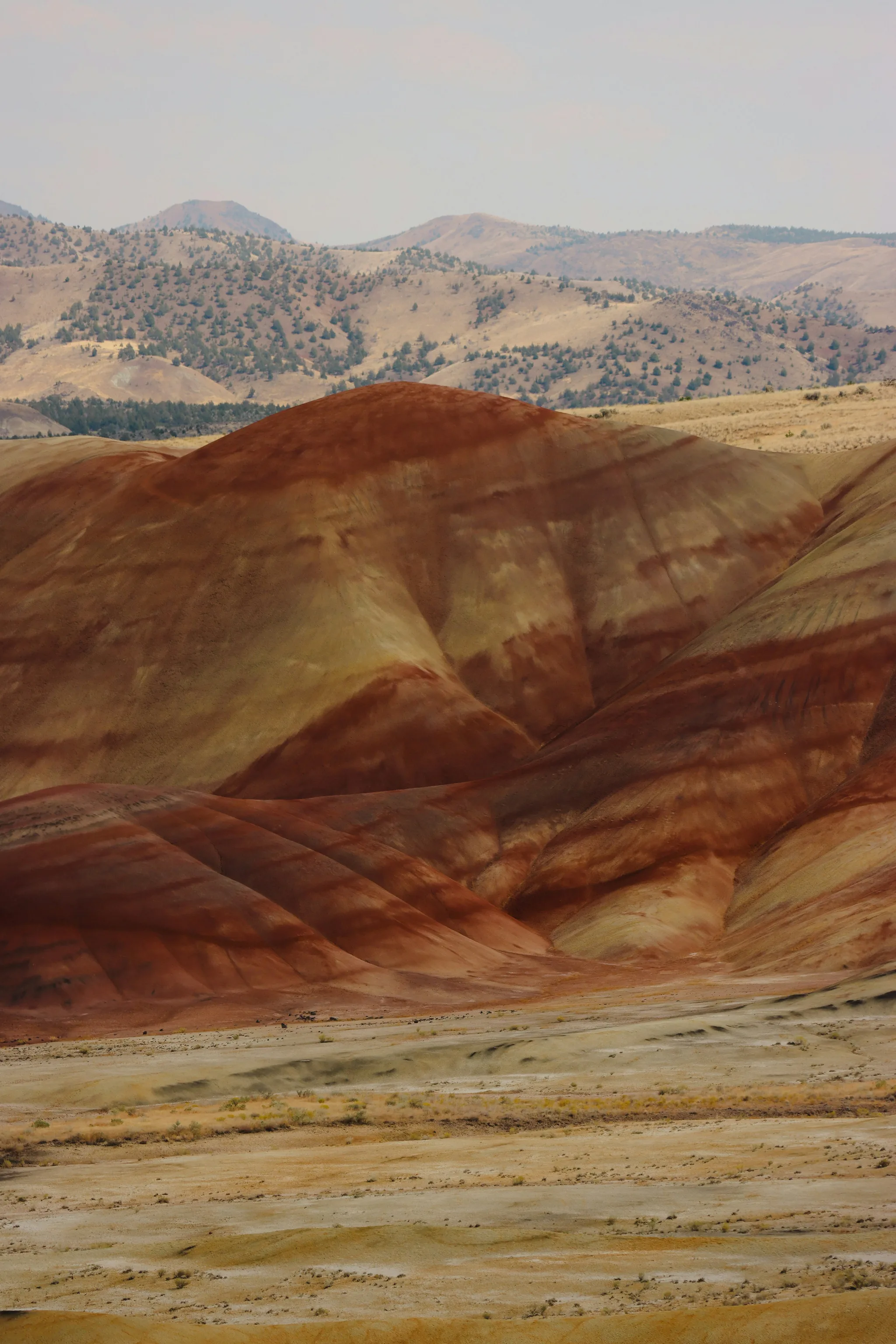
Ancient volcanic ash layers in Oregon's John Day Fossil Beds, stained in vivid bands of red, gold, black, and khaki that shift with the light — a 35-million-year geological canvas exposed at the surface of time.
Thirty-five million years ago, a series of volcanic eruptions to the west deposited successive layers of ash across what is now north-central Oregon. Each layer carried different mineral compositions. Each composition, after millions of years of chemical weathering under varying conditions of moisture and temperature, produced a different color. The result — exposed at the surface by erosion across the last few million years — is the Painted Hills unit of the John Day Fossil Beds National Monument: horizontal bands of deep red, pale cream, golden yellow, black, and khaki running across low rolling hills in a pattern that reads as painted because no other word fits.
The Painted Hills cover approximately 14,000 acres in Wheeler County, in the high desert of central Oregon. The colors come from specific mineral deposits laid down across specific geological periods. The deep red and orange tones are oxidized iron in laterite soils — ancient tropical weathering surfaces from periods of warm, wet climate, 40–50 million years ago. The black layers are manganese dioxide from ancient swampy conditions. The yellow and khaki tones are volcanic ash that weathered under progressively drier conditions. The pale cream hillsides are compressed bentonite clay. Together they form an involuntary stratigraphic record of Oregon's climate history across 35 million years, written in color across the landscape at a scale that is readable from the road.
The formations shift in appearance with the light in ways that are difficult to photograph accurately. In flat overcast light, the palette is muted and the layering reads as geological evidence — interesting but clinical. At sunrise and sunset, when low-angle light hits the hillsides at oblique angles, the red tones intensify toward a deep terracotta that is almost violent in its saturation. After rain, when the clay soils are briefly wet, the saturation increases across the full color range. A single hill can look four different colors across the span of a single day, as the sun changes angle and the cloud cover shifts.
John Day Fossil Beds National Monument was established in 1975 to protect not just the visual formations but the paleontological record preserved within them. Fossils of subtropical plant species found in the lower geological layers indicate that Oregon's high desert was once a warm, moist lowland forest — the kind of environment that exists today only in Central America. The Painted Hills are a record of the gradual transformation of the Pacific Northwest from tropical to arid, documented in the mineral chemistry of layers of ancient volcanic ash.
There are no entrance fees and no lodging within the monument. The Painted Hills Overlook Trail — 0.5 miles, minimal elevation change — reaches the primary viewpoint in about 20 minutes from the trailhead. Most experienced visitors arrive at golden hour, in spring or autumn, to avoid the midsummer heat. From the overlook, the hills arrange themselves in a panorama whose geological explanation is fully available and whose visual effect is entirely irreducible to it. The science accounts for the colors. It does not account for the response.
Safety information
Safety information is not available yet.
Before visiting this place, check current safety guidance, access rules, local restrictions, and official updates on other trusted websites. Our editorial team does not have verified safety information for this location at the moment; it will appear here later.