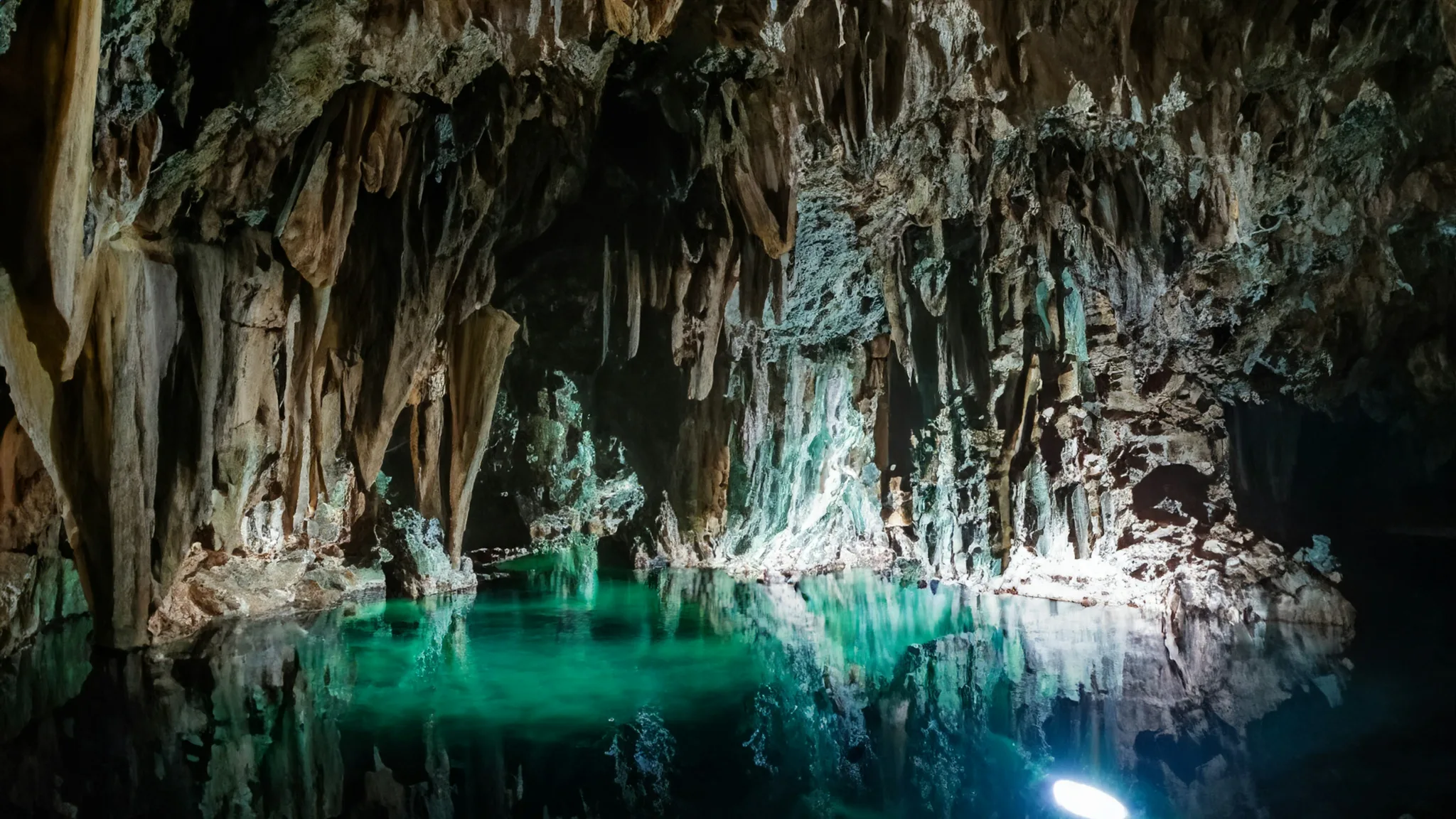
The Cueva de los Cristales beneath Naica Mine, Chihuahua — a hellish chamber 300 meters underground containing the largest natural crystals ever discovered: selenite columns up to 12 meters long, grown over half a million years.
The Cueva de los Cristales was discovered in 2000 by miners drilling exploration tunnels beneath the Naica silver and lead mine in Chihuahua, Mexico. At 300 meters below the surface, a drill broke into a sealed chamber filled with water. The water was pumped out. What was revealed was a geological formation without precedent in documented exploration: a cave containing the largest natural crystals ever found — columns and beams of selenite gypsum up to 12 meters in length, 4 meters in diameter, and estimated at up to 55 metric tons each. The mine had been operating since 1794. The cave had been sealed and unknown for half a million years.
The crystals grew under conditions that required precise geological patience. The Naica fault system channels hydrothermal water saturated with calcium sulfate through the mountain at depth. At the level of the crystal cave, temperatures settled at approximately 58°C — the precise threshold at which the mineral anhydrite (dry calcium sulfate) begins to dissolve and its hydrated crystal form, selenite, slowly precipitates from solution. Over approximately 500,000 years of stable temperature, in a sealed chamber with no disturbance, crystals grew continuously at a rate of a few centimeters per millennium, reaching dimensions that no crystal formation accessible to science has ever matched.
Working inside the cave without protection kills within approximately 20 minutes. The combination of 58°C temperature and near-100% humidity overwhelms human thermoregulatory capacity — the lungs cannot cool the blood because the inhaled air is hotter than body temperature. Researchers have entered the cave wearing suits cooled by ice packs and breathing apparatus delivering refrigerated air, with session durations limited to 30–40 minutes. The cave has been studied by a small number of scientific teams since 2000; most geological and biological research conducted inside has been carried out under these constraints.
Biologists studying the cave discovered what may be some of the most ancient isolated microorganisms ever found. Samples extracted from fluid inclusions within the crystals contained microbial communities that had been sealed inside for between 10,000 and 50,000 years. When revived in laboratory conditions, some communities resumed metabolic activity. These findings have implications for astrobiology — crystals on other planetary bodies may contain similarly preserved biological records.
The Naica mine's industrial pumps remove 55,000 liters of water per minute to keep the lower tunnels accessible for mining operations. If the pumps stop, the lower levels flood within hours. The crystal cave, at 300 meters depth, would flood within days. The crystals would survive — they formed in water and are stable in it — but access would be permanently lost. The cave's existence as a place that can be entered depends entirely on a mining operation conducted for a different purpose, and mining at Naica has not operated continuously. The cave is always one operational decision away from returning to the conditions in which it spent the previous half million years.