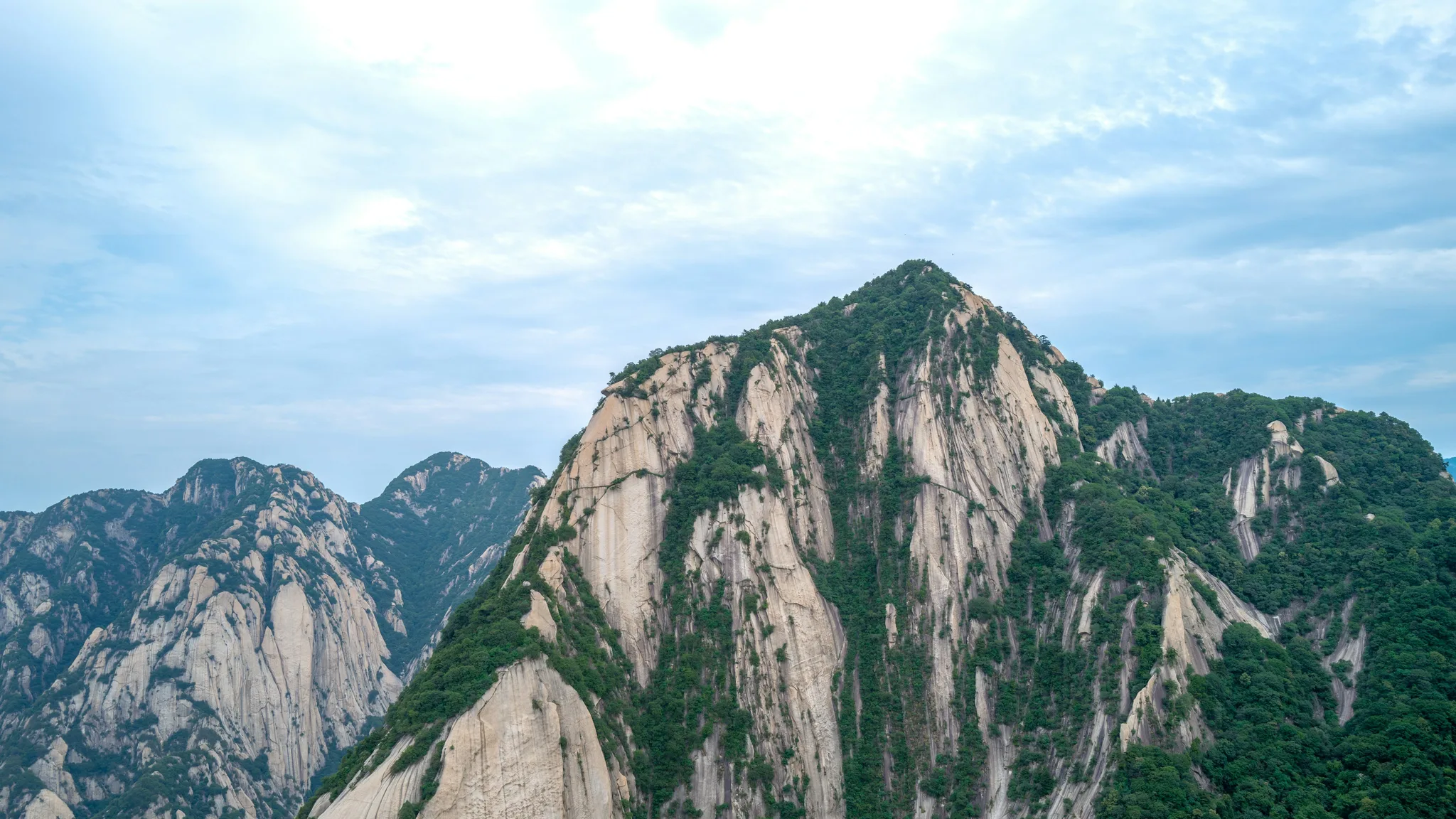
One of China's Five Sacred Mountains, home to the world's most dangerous hiking trail — narrow plank paths bolted to sheer granite cliffs 2,000 meters above the Wei River valley, where a single misstep ends the pilgrimage.
The plank path on Huashan Mountain's south peak is not a hiking trail. It is a narrow walkway of wooden boards bolted horizontally to a near-vertical granite cliff face, 2,100 meters above sea level, with a steel cable fixed to the rock above as a single handhold. The path is approximately 30 centimeters wide. In most sections, the cliff beneath the boards is essentially vertical. The approach to the path requires ascending a metal ladder fixed into a crack in the granite, harness clipped to a fixed safety line. At the end of the path, there is a small Taoist shrine and a tea house. People queue at the entrance.
Huashan — Flower Mountain — is one of China's Five Sacred Mountains (Wu Yue), among the most significant sites in Taoist cosmology for over two thousand years. The mountain rises from the Wei River valley in Shaanxi Province to five distinct peaks, the highest at 2,154 meters. The granite core was intruded deep into the earth 100–200 million years ago; erosion and tectonic uplift exposed it as a massif of exceptional verticality, with cliff faces that made the summit inaccessible to all but the most determined for most of Chinese history. This inaccessibility made it sacred. Hermits established cave residences on the cliff faces in the Han Dynasty. Monks built temples on the peaks. The difficulty of the route was understood as part of the practice.
The south peak plank path — the section designated the "World's Most Dangerous Hiking Trail" in the international media — was cut to provide access to a Taoist shrine wedged into a crack in the cliff. Visitors rent a harness at the base, clip to a fixed steel cable, and traverse the boards while managing occasional passing traffic in both directions. When two hikers meet on the path going opposite ways, one must unclip, step around the other person, and re-clip — on a board 30 centimeters wide above a thousand-meter drop. The protocol is practiced daily. It works.
The other routes on Huashan are strenuous but accessible without special equipment. The North Peak Cable Car serves the majority of visitors. The hiking route from the main gate at 400 meters elevation involves several thousand stone steps carved directly into the granite, including the Thousand-Foot Precipice and the Hundred-Foot Gorge — sections where chains bolted into the rock serve as handrails on paths barely wide enough for a single person. The round trip on foot takes 8–10 hours from the base. The path has been in use for 2,000 years.
Dawn from the east peak is the traditional reward — the Wei River valley spread below cloud level, the adjacent peaks catching the first horizontal light, and the knowledge that this view was earned by the same route that Taoist hermits climbed in the first century BCE. Huashan receives millions of visitors annually, mostly Chinese pilgrims and hikers on weekends. Spring and autumn offer the most manageable conditions. Winter turns the exposed granite paths icy and significantly raises the stakes on an experience that already does not need additional risk.