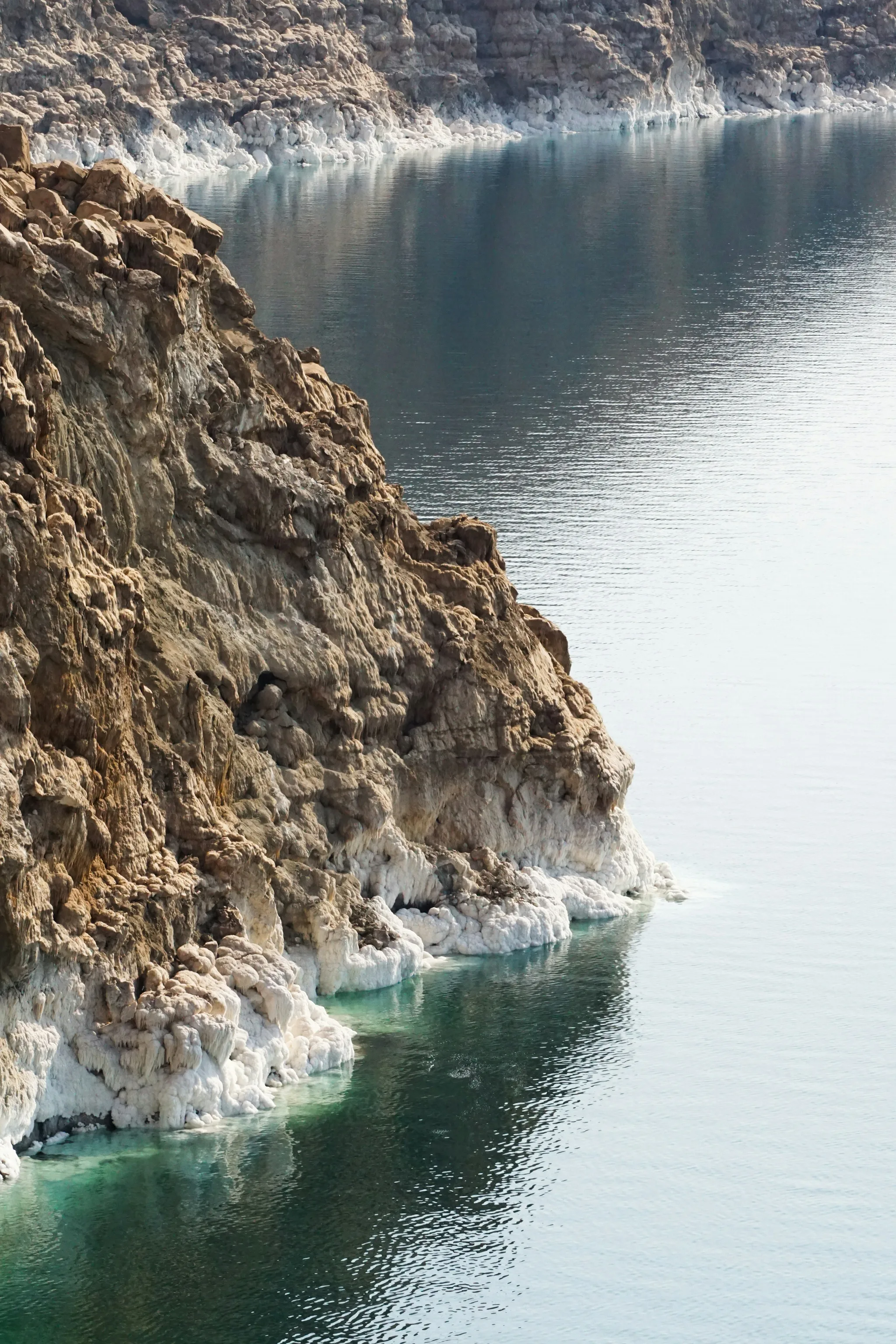
The lowest point on Earth's surface at 430 meters below sea level — a hypersaline lake so dense with mineral-rich water that the human body floats effortlessly, its shores encrusted with white salt crystals at the edge of the Judean Desert.
The Dead Sea sits 430 meters below sea level — the lowest permanently accessible point on Earth's surface. Not merely low; 430 meters below the nominal reference of sea level used by every survey instrument, elevation map, and GPS coordinate system in the world. The water surface is lower than any dry-land point on Earth except active cave systems and seafloor. This is a consequence of the Dead Sea Transform Fault, a major tectonic boundary along which the Arabian Plate is sliding northward relative to the African Plate, steadily deepening the Jordan Rift Valley and pulling the Dead Sea floor deeper with it. The lake sits at the bottom of a rift that is still being created.
The water is not dead in any geological sense — it is hyperactive, evaporating at rates far exceeding the Jordan River's supply, concentrating its mineral content continuously. The salinity is approximately 34 percent dissolved minerals by mass — nearly ten times that of typical ocean water. The dominant minerals are magnesium chloride, sodium chloride, calcium chloride, and potassium chloride, with trace quantities of approximately 21 additional elements. This concentration kills almost all conventional aquatic life: no fish, no conventional plants, essentially no macroscopic organisms in the water itself. Halobacteria and certain salt-tolerant algae are present; nothing else survives for long.
The physical experience of entering the Dead Sea is unlike any other body of water. The brine density — approximately 1.24 g/cm³ compared to seawater's 1.025 — makes the human body so buoyant that sinking below shoulder depth without active effort is not possible. The characteristic horizontal floating posture, typically shown with a book or newspaper, requires no physical skill to achieve. It requires only entering the water and relaxing. The lake is warm — 32–35°C in summer, warmer than most swimming pools. Contact leaves a mineral coating on the skin that dries quickly to a faint white crust in the hot, dry air of the rift valley.
The therapeutic tradition at the Dead Sea predates written history and is documented continuously from at least the first century BCE. Herod the Great used the mineral resources in medical treatments at his fortress at Masada and is documented as having bathed in the lake for relief from joint pain. The black mineral-rich mud that accumulates on the lakebed is commercially harvested and applied as a body treatment across resort hotels on both the Israeli and Jordanian shores, marketed for properties that ongoing dermatological research has found evidence for in cases of psoriasis and rheumatoid arthritis.
The Dead Sea is shrinking. Over-extraction from the Jordan River by Israel, Jordan, and the Palestinian territories has reduced inflow to a small fraction of historical volumes. The lake's surface area has decreased by approximately one-third since the 1960s. The retreating shoreline is leaving sinkholes — depressions formed as fresh groundwater, no longer balanced by the lake's salt water, dissolves the buried salt layers and causes sudden ground collapse. The shoreline infrastructure — hotels, beach facilities, access roads — must relocate periodically as the water retreats. The Dead Sea has outlasted every civilization that has lived on its shores. The question of whether it will outlast the current one is no longer entirely rhetorical.