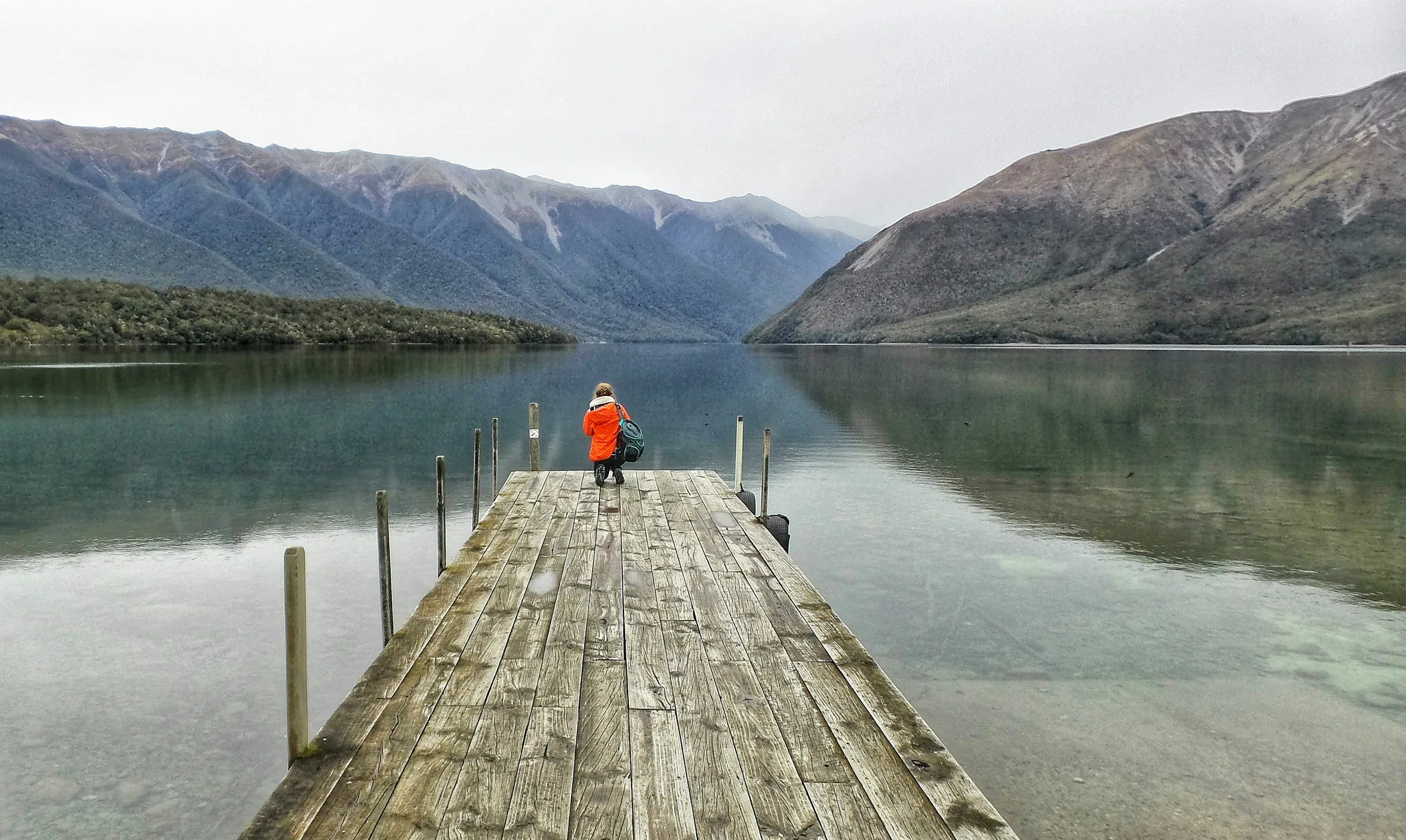
A remote alpine sanctuary at the northern tip of New Zealand's Southern Alps where crystalline glacial lakes are framed by ancient beech forests, and the water is so pure it appears to glow with a light of its own.
Nelson Lakes National Park occupies the northern tip of the Southern Alps — a corner of New Zealand that most international visitors overlook in favor of the better-marketed landscapes further south. This oversight is the park's most valuable quality. It holds the same glacially carved topography as Fiordland and Aoraki-Mount Cook — crystalline lakes, ancient beech forest, high alpine ridgelines — but without the visitor volumes those parks absorb. On most mornings at Lake Rotoiti or Lake Rotoroa, the water is mirror-still and the surrounding forest is unoccupied by anyone.
The two main lakes were formed by glacial advance and retreat over the last two million years. As ice masses move down mountain valleys, they scour the bedrock into deep U-shaped basins; when the glaciers retreat, meltwater fills what the ice left behind. Lake Rotoiti and Lake Rotoroa are the result — extraordinarily cold, extraordinarily clear, fed by streams filtered through old-growth catchment that has never been cleared. Water visibility in Rotoiti regularly exceeds 15 meters. The color of both lakes varies from pale teal in shallow areas to a deep mineral blue at depth, shifting constantly with cloud cover and angle of light.
The beech forest that surrounds the lakes is one of the park's primary ecological features. Podocarp-hardwood forest of this character once covered much of New Zealand; most of it was cleared following Polynesian and European settlement. Nelson Lakes preserves one of the largest continuous remnants on the South Island. The forest is dense enough and intact enough to support the full range of native bird species that historically inhabited it. Kea — the alpine parrot, one of the most cognitively capable birds in the world — inhabit the ranges above the treeline. Tui, bellbirds, kākā, and tomtit call from the canopy. The dawn chorus in the pest-controlled sanctuaries established along the lakeshore is closer to what pre-human New Zealand sounded like than almost any other place accessible without a helicopter.
The park sits directly on the Alpine Fault, the major tectonic boundary running down the spine of the South Island where the Pacific and Australian plates meet. The fault is still active — the Southern Alps are still rising, still being eroded, the two tectonic forces running against each other in a geological balance that produces small earthquakes almost daily and a landscape that is always, imperceptibly, in motion.
For hikers, the park offers everything from short lakeside walks to multi-day alpine traverses through the St Arnaud and Richmond ranges. The Travers-Sabine Circuit — a six-day loop through high passes and river valleys — is one of the most complete wilderness routes in New Zealand. The best months are December through March for settled weather and long days. What Nelson Lakes lacks in international fame it returns in silence, in the quality of the water, and in the particular feeling of arriving somewhere that has not yet decided to perform for anyone.