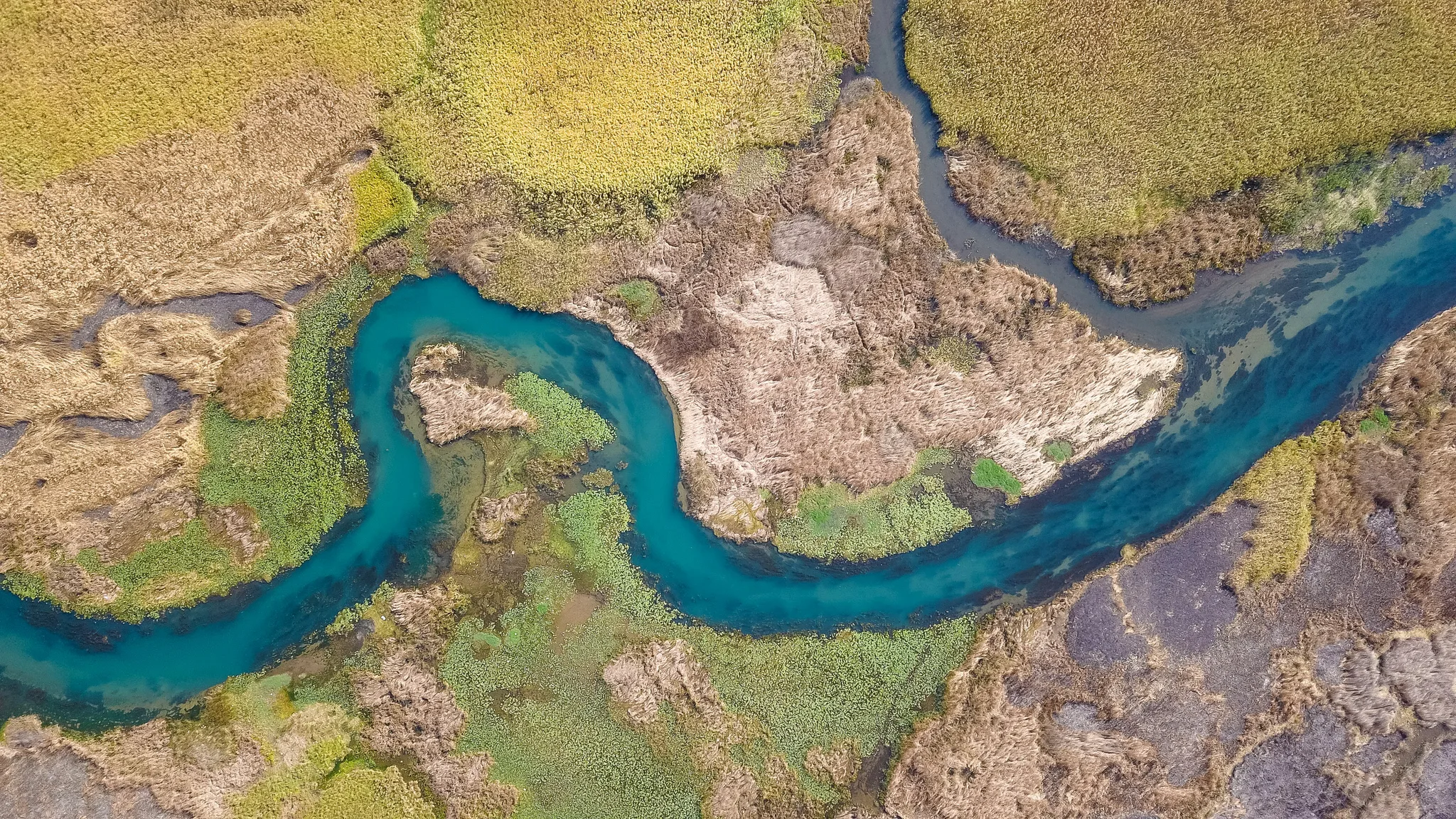
In the heart of Geneva, the milky turquoise Rhône and the muddy grey Arve meet and refuse to merge for hundreds of meters — two worlds flowing side by side in the same channel, invisible to each other.
At a precise point in central Geneva, two rivers meet and refuse to merge. The Rhône arrives from Lake Geneva — clear, fast-moving, colored a distinctive milky turquoise from suspended glacial sediment carried down from the Alps. The Arve descends from the Mont Blanc massif — grey-brown, slower, heavy with runoff from glacial meltwater and mountain streams. When they meet, they flow side by side for hundreds of meters in the same channel, each retaining its color and chemistry, as if the river itself were undecided about what it wanted to be. Two different worlds, sharing a bed, not yet the same thing.
The phenomenon is called laminar flow — the technical term for fluid movement where adjacent layers slide past each other without turbulence mixing them. Two rivers joining in the same channel will remain visually and chemically separate for a significant distance when their flow rates and densities differ enough that turbulence cannot bridge the boundary. The Rhône and the Arve are strikingly different in both: the Rhône is colder and denser from Lake Geneva, the Arve warmer and sediment-loaded from its shorter, steeper descent. The visual boundary between them is sharp enough to read clearly from the bridges above — a line where grey meets turquoise with the definition of a wall.
The confluence is visible from the Jonction neighborhood in Geneva's western district, where a small park occupies the peninsula formed between the two rivers. From the park's southern tip you can stand within meters of the meeting point and watch the two flows running in parallel. The contrast is sharpest in spring, when snowmelt from the Mont Blanc glaciers is at peak volume and the Arve carries its heaviest sediment load. In summer, when both rivers run lower and clearer, the visual difference diminishes but never disappears entirely.
Geneva is not typically listed among Europe's great natural spectacles. It is a city famous for precision instruments, international diplomacy, and financial services. But this junction of waters, visible from unremarkable pedestrian bridges in a municipal park, is one of the more genuinely strange natural sights available in a European capital. The city has grown around it without especially advertising it. There are no signs directing visitors to the Jonction. Most people who know the confluence found it by walking in the right direction.
The two rivers do eventually merge. The boundary dissolves gradually over several kilometers downstream as turbulence and mixing overcome the density difference. By the time the river crosses into France, it is one thing. But for those first hundreds of meters in Geneva, it remains two — a demonstration that proximity does not require unity, and that two fundamentally different things can occupy the same space for a long time before becoming indistinguishable from each other.