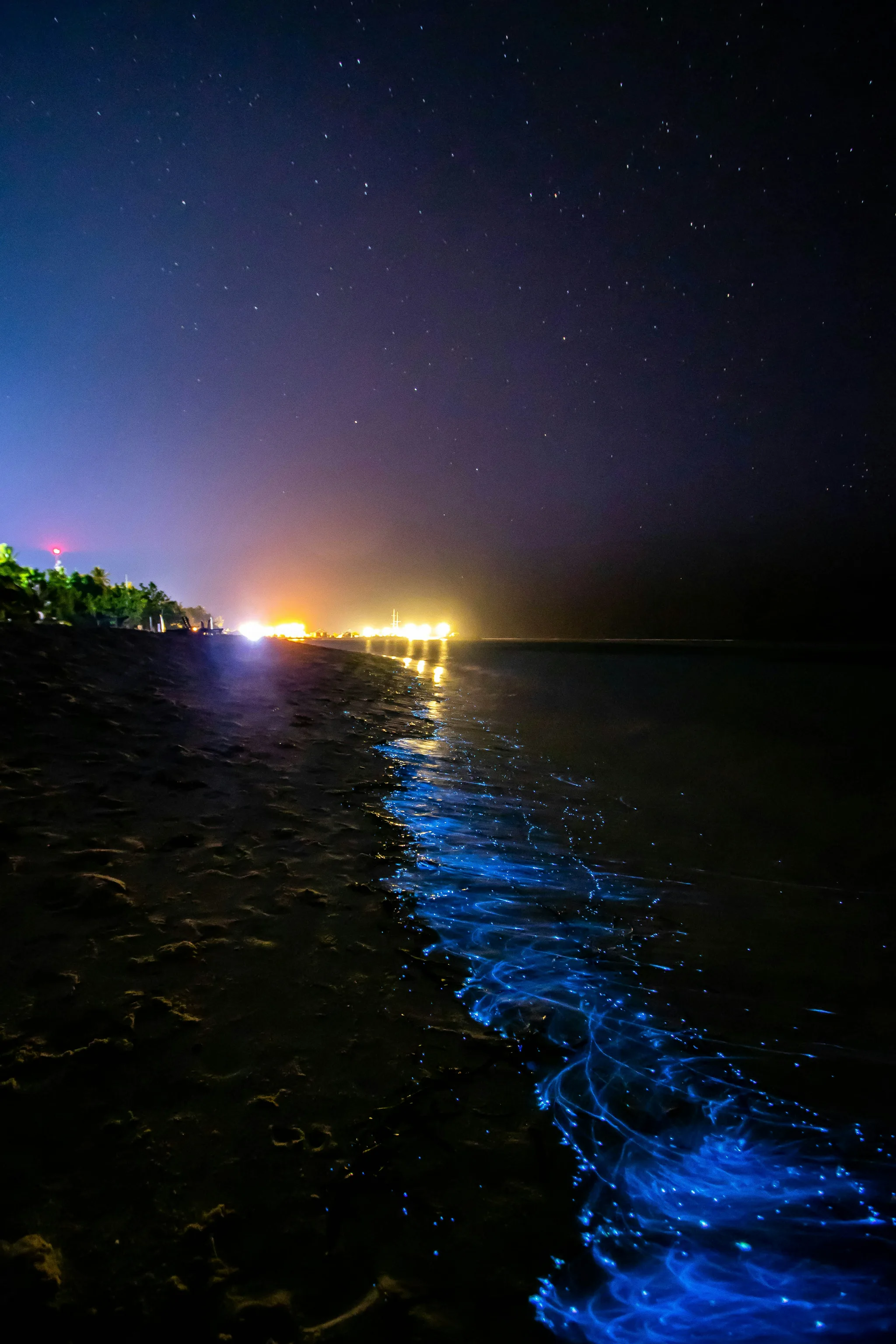
On Vaadhoo Island's beach, bioluminescent phytoplankton wash ashore with every wave, turning the shoreline into a mirror of the Milky Way — the ocean itself glowing electric blue in the tropical darkness.
On most nights, the shoreline of Vaadhoo Island in the Maldives looks like a beach. Dark sand, dark water, the sounds of small waves. Then a wave breaks, and for a fraction of a second the foam lights up from inside — a pulse of cold blue fire tracing the exact shape of the wave as it runs along the sand, then extinguishing. Another wave comes. Another pulse. After a few minutes, your eyes adjust and you start to see it not just in the waves but in every disturbance of the water: a fish breaking the surface, a hand dragged through the shallows, footprints left in the wet sand at the water's edge.
The light is produced by Noctiluca scintillans — sea sparkle — a single-celled marine organism classified among the dinoflagellates. Noctiluca produces bioluminescence through a biochemical reaction involving luciferin and luciferase, triggered by physical disturbance of the water. When something moves the cells — a wave, a swimming animal, a hand — they respond by emitting a brief pulse of blue-green light. Each individual cell produces negligible illumination. In the concentrations that gather in warm, calm, nutrient-rich coastal water, the collective light is visible to the naked eye with a quality that the word "glow" doesn't quite capture. It is more abrupt than a glow. It is closer to a flash — a biological signal, repeated millions of times per second across every disturbed surface.
Vaadhoo is a small inhabited island in the Raa Atoll of the northern Maldives, with a permanent population of a few hundred people. It became internationally recognized through a 2011 photograph by Taiwanese photographer Will Ho, which showed the bioluminescent shoreline reflected in still water under a clear night sky — the electric blue from the water and the Milky Way overhead captured in a single frame that placed Vaadhoo on lists of surreal destinations worldwide.
The phenomenon is not unique to Vaadhoo — Noctiluca scintillans blooms occur in warm coastal waters across the Indian Ocean, Pacific, and Atlantic. What distinguishes Vaadhoo and the southern Maldivian islands is the consistency and density of the blooms, driven by the combination of warm water temperatures, atoll-sheltered calm, and nutrient upwelling from the Indian Ocean. The blooms are most reliable between June and November during the southwest monsoon season, when surface water conditions favor dense phytoplankton accumulation.
There is no infrastructure oriented around the light show on Vaadhoo. You walk to the beach after dark. You wait for your eyes to adjust. The waves begin to read differently — each one a brief illuminated line, a proof of something alive in the water in numbers beyond counting, disturbed by nothing more than gravity and the pull of the moon.
Safety information
Safety information is not available yet.
Before visiting this place, check current safety guidance, access rules, local restrictions, and official updates on other trusted websites. Our editorial team does not have verified safety information for this location at the moment; it will appear here later.