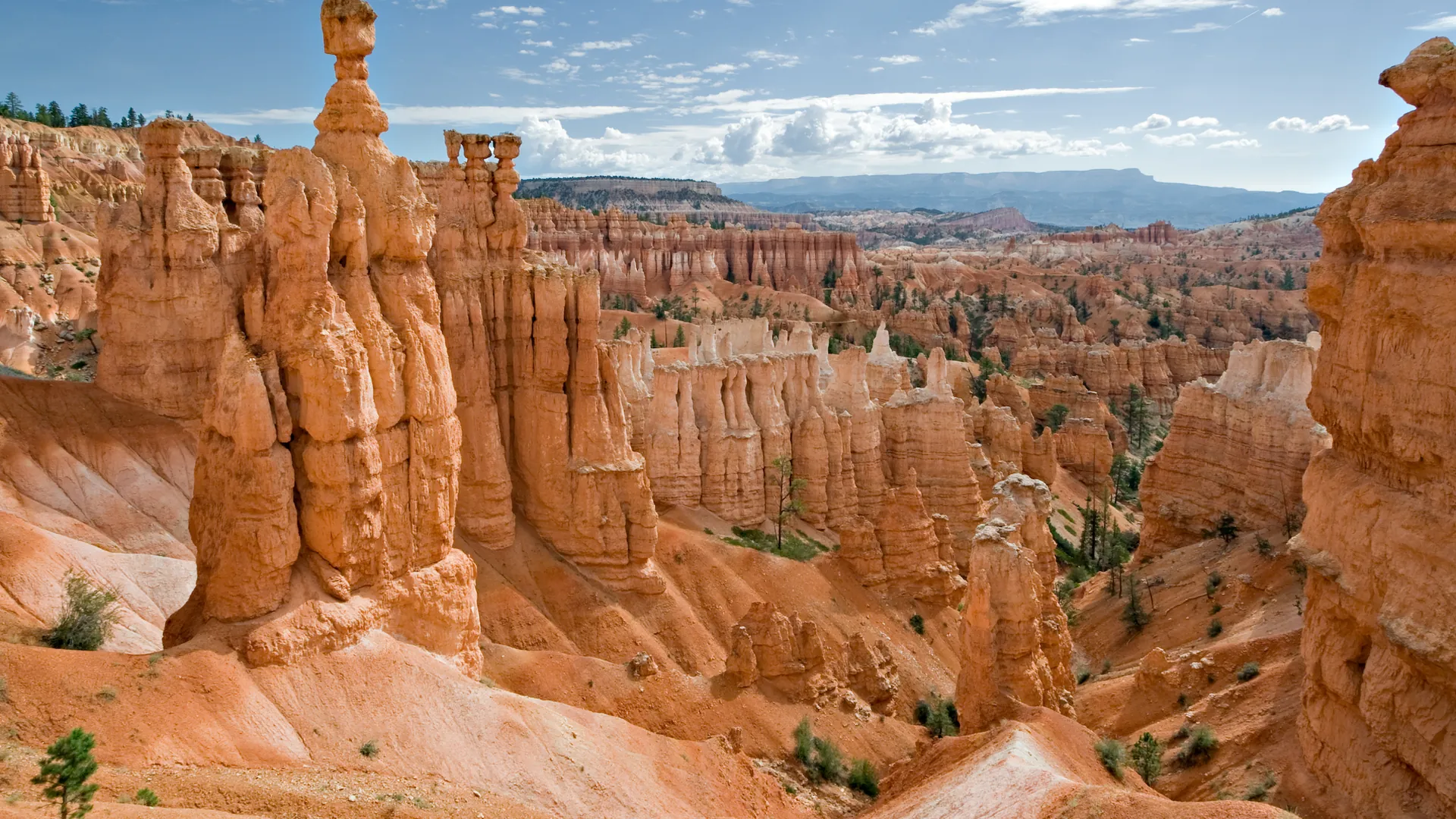
Bryce Canyon is not a canyon but a series of natural amphitheatres carved into the Paunsaugunt Plateau — filled with thousands of hoodoos, orange and red and white, spires of rock reaching 60 metres, formed by the precise mechanics of freeze, thaw, and dissolution across three million years.
The word canyon is technically incorrect. Bryce Canyon is a series of horseshoe-shaped amphitheatres cut into the eastern edge of the Paunsaugunt Plateau in southern Utah — the result of 50 million years of geological uplift and three million years of erosion. The Colorado River system drains the plateau; the actual cutting is done by rainwater and freeze-thaw cycles working on limestone, siltstone, and mudstone laid down in an ancient lake.
What fills the amphitheatres are hoodoos: spires of rock rising in some cases to 60 metres, standing in thousands, the result of a precise geological process. A cap of resistant limestone protects softer rock below from direct rainfall. But water seeps into vertical cracks and freezes — Bryce sits above 2,400 metres, experiencing over 200 freeze-thaw cycles per year. The ice expands the crack; the wall between two cracks becomes thinner; eventually what remains is a tower, its base narrower than its crown, tapering toward the ground in the characteristic hoodoo form.
The colours are the product of iron oxide in different concentrations: hematite gives orange and red, goethite gives yellow, higher concentrations of manganese produce purple. The amphitheatre at sunrise catches the first light on east-facing hoodoo walls while the west faces remain in shadow — the colour contrast between the lit orange surfaces and the dark spires is at its most extreme in the twenty minutes after dawn.
The Paiute people who lived in this area called the hoodoos Anka-tu-wass-witch: red rocks standing like men in a bowl-shaped canyon. Their tradition held that the formations were the Legend People, animal-spirits transformed into human form and then punished by Coyote, who turned them to stone. Walking among the hoodoos at floor level, the formations do read as figures: the way they stand in configurations that suggest crowds and processions, the plateau enormous above them, the sky around them open. The hoodoos do not move, but they seem to.
Safety information
Safety information is not available yet.
Before visiting this place, check current safety guidance, access rules, local restrictions, and official updates on other trusted websites. Our editorial team does not have verified safety information for this location at the moment; it will appear here later.