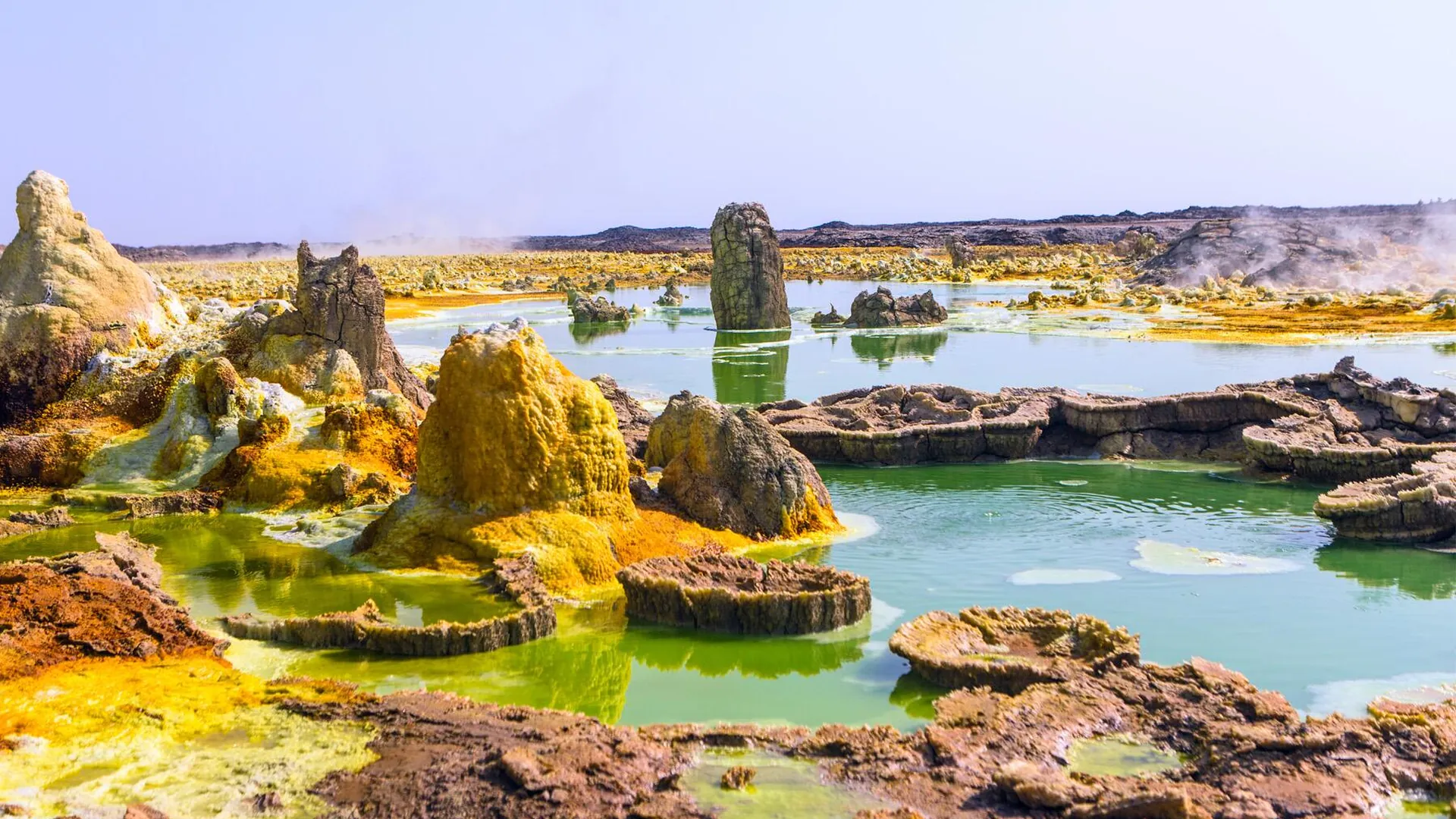
A volcanic crater in the Danakil Depression, 48 metres below sea level, where hydrothermal vents create pools of sulphuric acid and salt formations in electric yellows, greens, and oranges — the most alien landscape on Earth.
Dallol sits 48 metres below sea level in the Danakil Depression of northern Ethiopia — one of the lowest, hottest, most inhospitable places on Earth''s surface. The average annual temperature is 34.4°C, and this is the average. The summer heat reaches 50°C. The ground itself is hostile: sulphuric acid pools, salt columns, hydrothermal vents releasing toxic gases. The landscape is yellow and orange and green in colours so saturated that photographs of it are regularly assumed to be false-colour processed.
They are not. The colours are real. The hydrothermal system beneath Dallol is heated by a magma intrusion very close to the surface, and the mineral-rich water that rises through the vents deposits thick crusts of salt and sulphur in formations that look like alien coral — columns, mushroom shapes, rippled pools edged in neon green from halophile bacteria that survive in the acid.
The Afar people have mined salt from this area for centuries. They travel here on camel trains, cutting blocks of salt from the surface and carrying them to markets hundreds of kilometres away. They are, by any measure, accustomed to extreme environments. Even the Afar do not linger at Dallol.
There is no permanent settlement. The gases are toxic. The ground can give way into pools of acid. The heat is survivable only in short exposures. Scientists who study the site work in shifts, and the window of access each year is narrow. The colour remains regardless of the season, regardless of whether anyone is present to witness it.
Interesting facts
Can tourists visit Dallol freely?
Not without arrangement. Following a 2012 attack that killed several foreign tourists near the site, access to the Danakil Depression has required armed escorts, government permits, and organised tour groups rather than independent travel.
What are the salt slabs the Afar caravans carry called?
They're known as "amoles" — rectangular blocks cut by hand from the salt pan using simple tools. For centuries they functioned as a form of currency across highland Ethiopia, and camel and donkey caravans still haul them out to markets in Mekele today.
Why do space agencies take an interest in a salt flat in Ethiopia?
Dallol's scalding, hyper-acidic, mineral-saturated pools host microorganisms that survive in conditions once thought incompatible with life. Astrobiologists study them as a working model for how life might persist in similarly extreme environments on Mars or other planets.
Is the Danakil Depression actually becoming a new ocean?
The Danakil sits at the point where the African, Somali, and Arabian tectonic plates are slowly pulling apart, at roughly the rate fingernails grow. Geologists expect that over the next several million years the rift will widen enough for the Red Sea to flood in and create an entirely new ocean basin.
Why does the ground come in so many different colours?
Each colour marks a different mineral precipitating out of the hydrothermal fluids as they cool and evaporate: iron oxides produce the reds and oranges, elemental sulphur produces the yellows, and potassium and chlorine salts crystallise out as pale greens and whites.
How did the Dallol crater form?
It was created by a phreatic eruption in 1926, when magma rising close to the surface flash-heated groundwater trapped beneath the salt flat until it exploded outward. Unlike ordinary lava eruptions, no molten rock reached the surface — only steam, gas, and shattered salt.
What does the name "Dallol" actually mean?
It comes from the Afar word for "disintegration" or "dissolution" — a reference to how the salt crust underfoot constantly cracks, dissolves, and reforms, making the ground itself unstable and short-lived.
Does Dallol hold an official temperature record?
Yes — a nearby weather station recorded the highest average annual temperature ever measured for a permanently inhabited location on Earth, based on data collected between 1960 and 1966. The Guinness-recognized figure sits at 34.4°C (94°F).
Safety information
Safety information is not available yet.
Before visiting this place, check current safety guidance, access rules, local restrictions, and official updates on other trusted websites. Our editorial team does not have verified safety information for this location at the moment; it will appear here later.