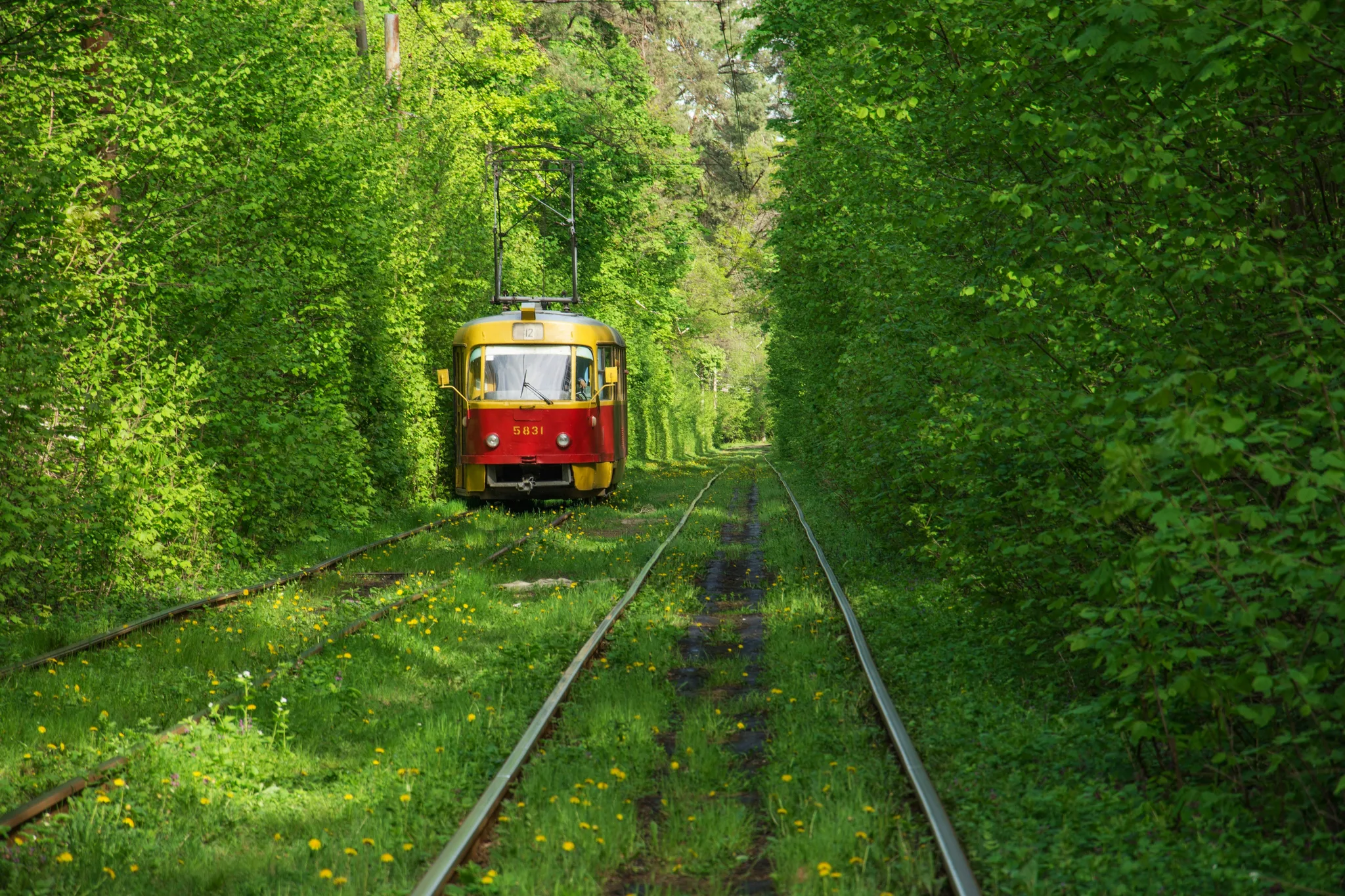
A 3-kilometer railway corridor near Klevan where oak and hornbeam trees have grown into a perfect green cathedral over the tracks — still used by a local factory train, and said to grant wishes to those who walk it in love.
Between the Ukrainian towns of Klevan and Orzhiv, a section of a narrow-gauge industrial railway runs for approximately three kilometers under a continuous arch of oak, hornbeam, and ash trees whose canopy has grown over the tracks and intertwined above them into something that functions during the growing season as an enclosed green corridor. The railway was built to supply a local furniture factory. The trees were not planted as a designed feature. They simply grew, over decades, in the direction that available light and the absence of obstruction allowed.
The Tunnel of Love — Тунель кохання — acquired its name through local custom rather than official designation. Couples who walked the full length of the track through the tunnel were said to have their wishes granted, provided they completed the walk together. The origin of this custom is not documented with any precision, but the tunnel's enclosed quality, the color of the light filtering through the leaf canopy, and the way the railway track disappears into green distance ahead all contribute to an atmosphere that the custom seems to have grown from naturally. It is a place that invites projection.
The railway is still operational. A small locomotive makes three runs per day between the factory and the Klevan rail junction, each run passing through the full length of the tunnel. The track is the original Soviet-era narrow gauge — 600 millimeters between the rails — installed to serve the factory and never upgraded. The locomotive's schedule is informal; visitors who time their walk correctly encounter it passing through the green corridor, smoke rising through the canopy, the sound arriving before the train is visible through the trees. The encounter is brief and memorable.
The tunnel is at its most complete from May through October, when the deciduous canopy is full and the track corridor is enclosed on all sides and above. In spring, when the leaves are just emerging, the light is brighter and the walls more open. In autumn, when the leaves begin to turn, the color shifts from deep green to amber and yellow. By November, the tunnel opens entirely until the following spring, and the railway reads as an ordinary industrial track. The experience is entirely dependent on the season, which is not true of most natural landmarks.
Klevan is approximately 30 kilometers from Rivne in western Ukraine, reachable by local train from Kyiv in under four hours. The tunnel entrance is a 15-minute walk from the Klevan station. The walk itself — the three kilometers of track between Klevan and Orzhiv — is the entire experience. There is no viewpoint, no summit, no destination other than the other end. What the tunnel offers is the time inside it: the filtered light, the quality of sound when enclosed by living walls, and the simple fact of a working industrial railway that happened to grow into something that people travel across Ukraine to walk.
Interesting facts
How do you get there?
Klevan is about 30 kilometers from Rivne in western Ukraine, reachable by local train from Kyiv in under four hours. The tunnel entrance is a 15-minute walk from Klevan station. No ticket, no fee, no formal infrastructure — the path simply begins where the trees do. The tunnel is on active railway tracks, so awareness of the train schedule is not optional.
How long does it take to walk the tunnel?
The tunnel runs for approximately 3 kilometers between the towns of Klevan and Orzhiv. Walking at a relaxed pace takes 35–45 minutes one way. There is no viewpoint, no summit, no destination other than the other end. The walk itself is the entire experience — the filtered light, the living walls, the sound of the forest closing in around a working railway track. Most people walk it in both directions.
Does the tunnel exist year-round?
Only from May through October. The tunnel is formed by deciduous trees, so when leaves fall in November, the green cathedral opens entirely and the track becomes an ordinary industrial railway until spring. Even within the season, the experience shifts: early spring light is bright and open as leaves emerge; summer brings complete enclosure in deep green; autumn turns the walls amber and yellow before they vanish. The tunnel is not a fixed landmark — it is a temporary condition that reassembles itself each year.
Where does the wish-granting legend come from?
No one knows exactly. The custom — that couples who walk the full 3 kilometers together will have their wish granted — was never officially created or documented. It grew from the tunnel itself: the way the track disappears into green distance, the quality of filtered light, the enclosed silence. The place invites projection. At some point, local couples started walking it with intentions, and the legend followed. It is less a story someone invented and more a story the tunnel generated on its own.
Does a real train actually run through it?
Yes — three times a day. A small locomotive on Soviet narrow-gauge tracks (600mm between the rails) runs between a local furniture factory and the Klevan rail junction, passing through the full 3-kilometer length of the tunnel each time. Visitors who time their walk right encounter the train emerging from the green darkness: the sound arrives before the train is visible, and smoke rises through the canopy above. The railway has never been upgraded. It still serves its original industrial purpose.
Were these trees planted to create the tunnel?
No one planted them with this in mind. The trees — oak, hornbeam, and ash — simply grew on their own along a Soviet-era factory railway and gradually arched their canopies inward over the tracks. No landscape architect. No deliberate design. The tunnel is entirely the result of decades of unchecked growth meeting the geometry of a narrow corridor. It happened by accident, which makes it stranger than if someone had planned it.
Safety information
Safety information is not available yet.
Before visiting this place, check current safety guidance, access rules, local restrictions, and official updates on other trusted websites. Our editorial team does not have verified safety information for this location at the moment; it will appear here later.