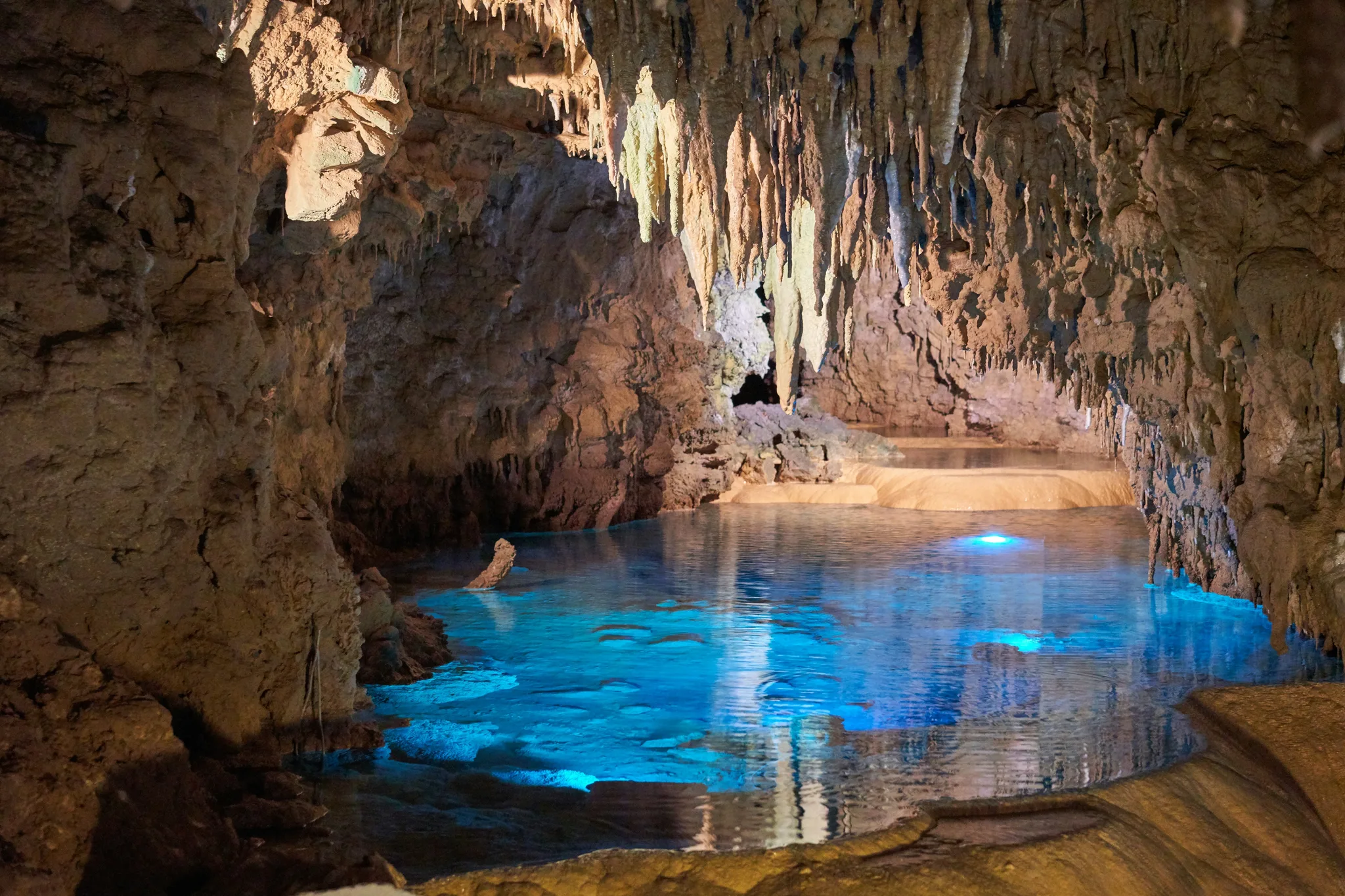
A network of limestone caves whose ceilings are covered with thousands of Arachnocampa luminosa — glowworms endemic to New Zealand that produce a steady blue-green bioluminescent light, transforming cave ceilings into the night sky.
Thirty million bioluminescent larvae cling to the ceiling. Each one has spun a nest of silk threads and hung beneath it dozens of sticky droplets on vertical lines — a fishing apparatus designed to catch fungus gnats, mayflies, and anything else drawn toward the faint blue light the larvae emit. The light is a byproduct of a chemical reaction between the compound luciferin and the enzyme luciferase in the larva's Malpighian tubules — the same chemistry that produces the glow of fireflies, evolved independently in the cave system of Waikato, in organisms found in significant concentrations nowhere else on Earth.
The Waitomo Glowworm Caves are a karst system cut through Oligocene limestone in the Waikato region of New Zealand's North Island. The limestone was laid down approximately 30 million years ago from the compressed remains of marine organisms in a shallow tropical sea. The Waitomo river has been cutting down through this limestone for approximately 100,000 years, carving the cave system that exists today. Three connected cave systems are open to the public: Waitomo Caves, Ruakuri Cave, and Aranui Cave — each offering a different cross-section of the karst processes and glowworm biology.
The primary experience is the Glowworm Cave, whose tour culminates in a silent boat ride across an underground lake beneath the Glowworm Grotto — a chamber whose ceiling is studded with thousands of Arachnocampa luminosa larvae, each emitting a cool blue-green light. The boat crosses in darkness and near-silence, because the larvae respond to vibration and light by dimming or retracting their fishing lines. From the boat, the ceiling reads as a field of stars — more stars than are visible from any dark sky site, closer, bluer, and entirely unmoving. The absence of wind, the still water, and the complete absence of any competing light or sound make this one of the most genuinely otherworldly enclosed experiences available in New Zealand.
Arachnocampa luminosa is endemic to New Zealand — it exists in the wild only here. A closely related species (Arachnocampa flava) produces similar bioluminescence in some Australian caves, but the Waitomo species is distinct. The glowworm is not actually a worm — it is the larval stage of a fungus gnat, Arachnocampa luminosa, which spends approximately 6 to 12 months as a larva before pupating and emerging as an adult gnat. The adult lives only a few days, does not feed, and exists solely to reproduce. The luminous larval stage is where all the energy is invested.
The caves are part of a living ecosystem — the larval populations are self-sustaining and have been studied continuously since European discovery in 1887. The Tainui people had been aware of the caves for much longer; the Māori name for the area, Waitomo, translates as "water passing through hole." The caves are operated under a joint venture between the Tainui-aligned tourism company and commercial operators. Visitor management is designed to minimize disruption to the larval colonies — the darkness and silence required during the boat ride are not atmospheric choices but biological necessities.
Safety information
Safety information is not available yet.
Before visiting this place, check current safety guidance, access rules, local restrictions, and official updates on other trusted websites. Our editorial team does not have verified safety information for this location at the moment; it will appear here later.