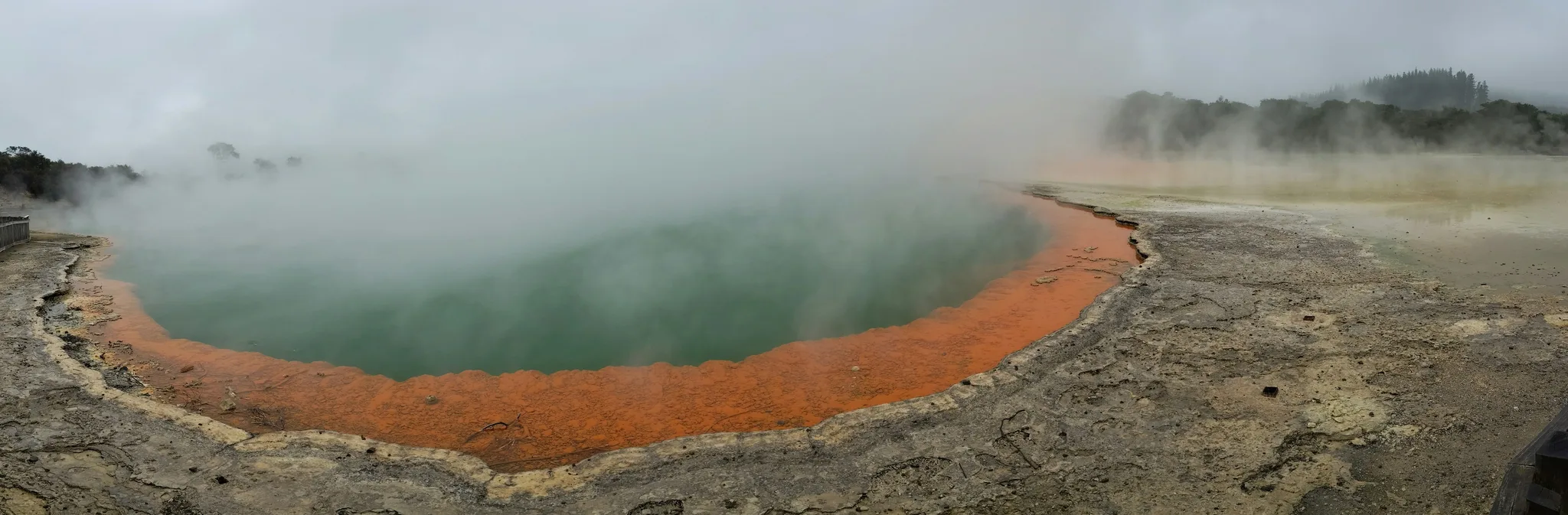
A 65-meter wide, 62-meter deep geothermal spring formed 900 years ago by a hydrothermal eruption, its 74°C waters edged with a vivid orange ring of arsenic-antimony sulfide deposits and trace amounts of actual gold.
Nine hundred years ago, a hydrothermal eruption tore open the earth at what is now the Wai-O-Tapu Thermal Wonderland in New Zealand's Taupo Volcanic Zone. The crater filled with water from deep geothermal sources — water at 74°C, continuously supersaturated with dissolved minerals, releasing carbon dioxide gas from depth. The gas is why the pool is named Champagne Pool: the surface is in constant motion, a steady rise of CO2 bubbles from the source water below, millions per minute, creating a texture on the surface unlike still water and unlike turbulence. The comparison to champagne is apt in appearance, inadequate in chemistry.
The water in Champagne Pool carries dissolved gold, silver, arsenic, antimony, thallium, and mercury — elements mobilized from deep hydrothermal sources and transported to the surface in solution. As the hot water reaches the pool's margins, where it contacts cooler groundwater and the surface air, the temperature drops and the chemical equilibrium changes. The dissolved elements precipitate out as the water cools, depositing as a vivid orange-red crust of arsenic-antimony sulfide around the entire perimeter of the 65-meter-wide pool. This mineral ring — visible as a dramatic orange band encircling the blue-green water — is actively forming. The pool has been depositing this crust for nine centuries. It is still making more.
The gold content is trace — approximately 143 grams per metric ton of water, according to geochemical analysis. This is insufficient for commercial extraction at current gold prices. But it is real and measurable, and the deposits around the pool's margins contain concentrations that have attracted serious scientific study. The pool is not producing gold bars; it is producing, slowly and continuously, a mineral record of the water chemistry that passes through it — a geological ledger, written in arsenic sulfide and precious metals.
The Taupo Volcanic Zone is one of the most thermally active regions on Earth — a 350-kilometer band of geothermal activity running from Ruapehu volcano in the south to the offshore volcanic islands north of Auckland, generated by the subduction of the Pacific Plate beneath the Australian Plate beneath North Island. Wai-O-Tapu contains multiple features produced by this activity: the Lady Knox Geyser (induced to erupt by soap — the surfactant reduces the surface tension and initiates the eruption mechanism), the Artist's Palette (a collection of multi-colored geothermal pools), and the Primrose Terrace, a silica terrace system similar in mechanism to the travertine terraces of Pamukkale.
Champagne Pool is accessible year-round on the Wai-O-Tapu circuit walk, approximately 90 minutes for the full loop. The site is operated as a commercial visitor attraction with an admission fee; visitor numbers are managed, and the path around the pool keeps visitors at a safe distance from the acid water and unstable geothermal ground. The pool's temperature of 74°C makes accidental entry immediately dangerous. The color, the movement, and the knowledge of what is dissolved in the water combine to produce a viewing experience that is fully engaging from the permitted distance without any need to approach further.
Safety information
Safety information is not available yet.
Before visiting this place, check current safety guidance, access rules, local restrictions, and official updates on other trusted websites. Our editorial team does not have verified safety information for this location at the moment; it will appear here later.