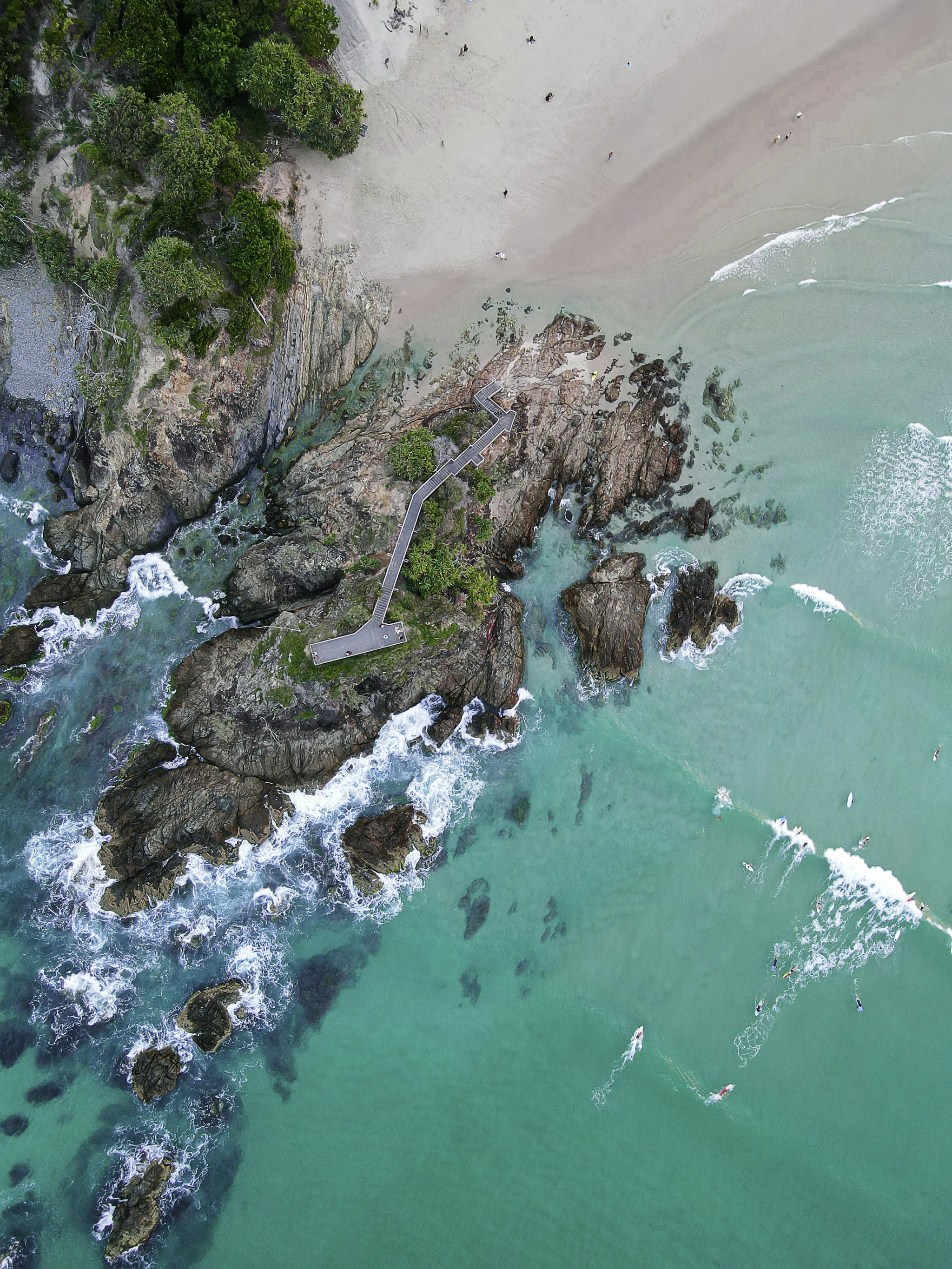
A sheltered bay of extraordinary clarity on Australia's south coast — declared the clearest water in the Southern Hemisphere — where summer nights bring spectacular bioluminescent plankton that light breaking waves electric blue.
Hyams Beach on the southern shore of Jervis Bay holds a Guinness World Record: the whitest beach sand on Earth. Silica so pure, so finely ground by wave action over geological time, that it reflects sunlight as brilliant white. Against the bay's turquoise water — a blue so saturated that new visitors consistently assume they have arrived somewhere in the Mediterranean rather than the south coast of New South Wales — the visual effect is so improbable that photographs of Hyams Beach are frequently dismissed as edited.
Jervis Bay's water clarity is a consequence of geology and oceanography working together. The bay is sheltered from the open Tasman Sea by the Beecroft Peninsula and the Bowen Island chain, which reduce wave energy and sediment disturbance significantly. The underlying geology is Permian sandstone and quartzite that weathers to large, pure silica particles rather than the fine clays that cloud water in other coastal systems. A cold, nutrient-poor upwelling from the deeper Tasman Sea keeps the bay's surface water biologically sparse — fewer phytoplankton, less organic matter, less color. Underwater visibility in Jervis Bay regularly exceeds 15 meters, which is unusual for any coastal system. The combination of white sand, shallow depth, and clear water produces the turquoise color: white light reflected off white sand, filtered through clear water.
The phenomenon that draws visitors specifically during summer is different. Between December and February, bioluminescent phytoplankton — principally Noctiluca scintillans and related dinoflagellates — bloom in the bay in concentrations sufficient to produce visible light when disturbed. Breaking waves glow from inside as the organisms flash in response to the mechanical disturbance. Swimmers moving through the shallows leave blue-lit trails. A hand dragged through the water produces a momentary ribbon of light. The bioluminescence at Jervis Bay is not unique to the region — the same organism blooms in many warm coastal systems worldwide — but the bay's clarity and the concentration of blooms during summer months make the effect particularly intense. Swimming in the bay on a bioluminescent night is one of those encounters that language handles poorly.
The bay encompasses both the Jervis Bay Territory (a small piece of Australian Capital Territory land on the bay's western shore, including the Australian Defence Force Academy's Creswell campus and HMAS Creswell naval station) and Jervis Bay National Park on the Bowen Island and Beecroft Peninsula sides. The national park section includes the bay's most significant seagrass meadows and the breeding grounds for little penguins and Australian fur seals. Bottlenose dolphins are resident year-round. Humpback whales pass through the bay during their northward migration in June and July and their southward return in October and November.
The town of Huskisson on the bay's northern shore serves as the primary visitor base. The two-hour drive from Sydney along the Princes Highway, combined with the bay's position relative to the ACT (Canberra is approximately 1.5 hours to the northwest), gives Jervis Bay an unusually high density of visitors relative to its size on summer weekends. The beach at Hyams Beach is walkable in its full length in under an hour, and the white sand underfoot has the distinctive cool, squeaking quality of pure silica — a texture that confirms the record before any documentation is needed.
Safety information
Safety information is not available yet.
Before visiting this place, check current safety guidance, access rules, local restrictions, and official updates on other trusted websites. Our editorial team does not have verified safety information for this location at the moment; it will appear here later.