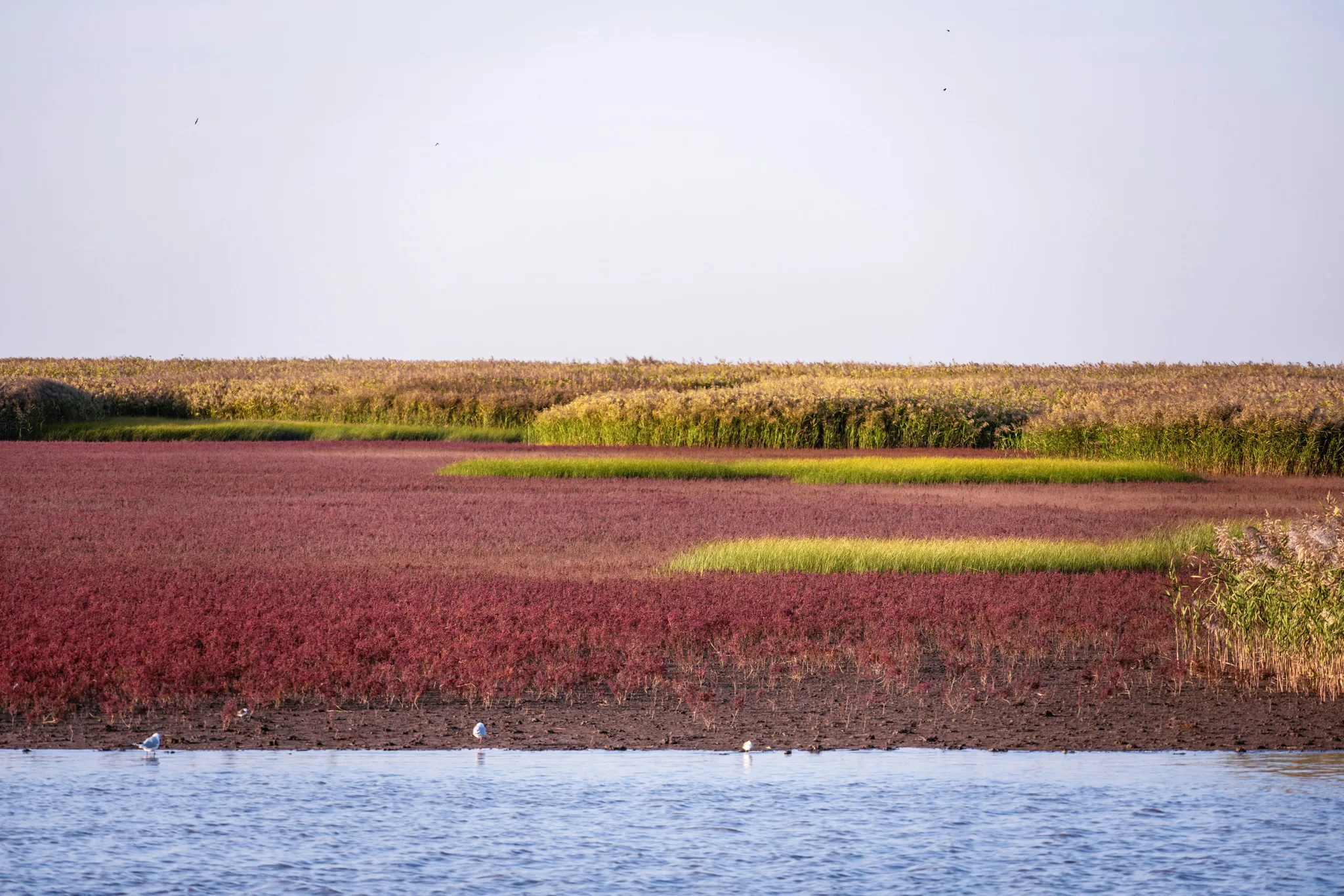
The world's largest Suaeda salsa wetland turns vivid crimson each autumn as the salt-tolerant succulent reaches peak color — a carpet of red stretching to the horizon along China's Liaohe River estuary.
Suaeda salsa is a halophyte — a plant specifically adapted to grow in salt concentrations that would kill most vegetation by drawing water out of roots through osmotic pressure. In the wetlands of the Liaohe River estuary in northeastern China's Liaoning Province, it has found its optimal environment: vast tidal flats where the soil salinity is high enough to eliminate competition from other plant species and the regular tidal flooding provides the moisture the plant requires. For most of the year, the Panjin wetlands appear as any coastal marsh would — green, boggy, populated by migratory waterbirds, productive and unremarkable to the eye.
Then September arrives. As the days shorten and temperatures drop in preparation for the northeastern Chinese winter, Suaeda salsa begins its annual pigment shift. Chlorophyll production declines; anthocyanin pigments accumulate. The plant shifts from green to red as the season progresses — the same chemistry that turns maple leaves in a New England autumn, applied at landscape scale across 80,000 hectares of tidal wetland. At peak color in October, the marsh becomes something for which red is an inadequate word. Crimson, wine-dark, vermillion — each of these is technically accurate and collectively insufficient. The color shifts with the angle of light, intensifies after rain, and saturates toward the horizon in a way that photographs flatten into something manageable that the physical experience is not.
From the elevated viewing platforms in the Panjin Red Beach National Scenic Area, the wetland extends to every visible horizon: a monochrome of red interrupted only by the silver threads of tidal channels winding through it, the white of egrets and cranes moving above it, and the occasional wooden walkway extending into the marsh like a sentence that ends mid-sentence in red. The scale is the thing: most red landscapes are intimate — a canyon wall, a rock formation, a small lake. The Red Beach is large in the way that tundra is large, that salt marsh is large, that only flat-lying landscape with a wide horizon can be. The color at that scale is different in kind from the same color at a smaller one.
The Panjin wetland supports significant migratory bird populations. The estuary is a staging and wintering area for the critically endangered red-crowned crane, one of the rarest birds in the world, which stops here during migrations between breeding grounds in Siberia and wintering areas in Korea and Japan. During peak migration in October and November, thousands of cranes use the wetland — their white plumage against the red ground is among the most dramatic wildlife juxtapositions available in East Asia. The wetland also supports black-faced spoonbills, white-naped cranes, and dozens of duck and shorebird species that use the tidal flats as a food source during passage.
The red color lasts approximately six weeks, peaking in mid-October. By November, frost arrives and the plants die back, and the marsh returns to its off-season appearance. The timing of peak color varies by a week or two from year to year depending on temperature patterns. The viewing season is short and specific — another of the places on Earth that can only be seen at one time, in one season, and only then for a few weeks before it becomes something else again.
Safety information
Safety information is not available yet.
Before visiting this place, check current safety guidance, access rules, local restrictions, and official updates on other trusted websites. Our editorial team does not have verified safety information for this location at the moment; it will appear here later.