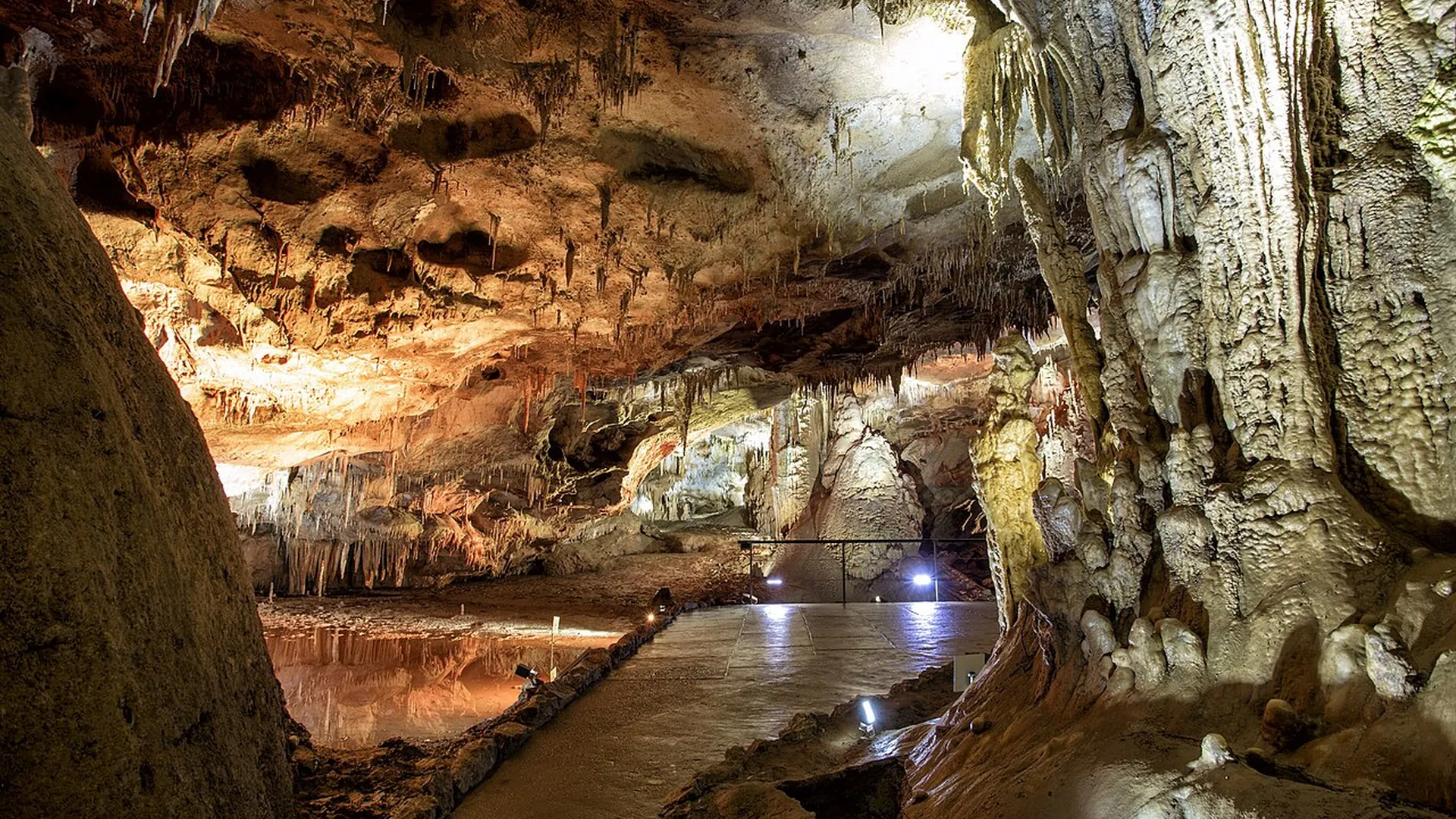
Prometheus Cave is a vast karst cave near Tsqaltubo in Georgia's Imereti region, also known as Kumistavi Cave. Its illuminated halls, limestone curtains, stalactites, stalagmites, and underground river system make it feel like a hidden architecture built below the Caucasus foothills.
Prometheus Cave begins as a contradiction: a landscape famous for mountains and forests suddenly turns inward. Near Tsqaltubo, the surface gives way to a cold limestone world where the earth seems to have been hollowed into halls, corridors, pools, curtains, and columns.
The cave belongs to the Sataphlia-Tskaltubo karst massif, a region where water has been quietly writing through rock for geological time. The full system stretches for kilometers, but the visitor route reveals only a controlled fragment of that hidden scale. That makes the experience stranger, not smaller: every lit chamber suggests more darkness beyond the path.
Before it became Prometheus Cave, the place was known as Kumistavi Cave. Georgian speleologists studied it in the early 1980s, and the Soviet-era plan to open it to visitors stalled after the collapse of the USSR. For years, the cave remained partly suspended between discovery and public life.
Its modern name arrived with myth. Prometheus, the fire-bringer punished in the Caucasus, gives the cave an almost theatrical identity: light appears underground, not as daylight, but as an act of staging. Stone folds glow in blue, amber, violet, and white, turning geological patience into something almost ceremonial.
The cave's real wonder is not only its decoration. It is the sense of a working planet. Water still moves below the floors and behind the walls. Limestone still records drip by drip. The beautiful chambers are not ruins of something finished; they are rooms inside a process still happening.
Interesting facts
Why does the visitor route show only part of the cave?
The full cave system is far larger than the public path. Limiting access protects fragile formations, manages safety, and keeps the deeper underground river system from being treated like a normal walkway.
Why are the formations still growing?
The cave is not a finished object. Mineral-rich water still drips through cracks, leaving thin deposits of calcite that slowly extend stalactites, stalagmites, and flowstone surfaces.
Why was the cave closed for so long?
Work to develop the cave for visitors began in the late Soviet period, but the project stopped after the USSR collapsed. It was restored much later and reopened as a visitor site in 2011.
Why is an underground river important here?
Prometheus Cave is part of a larger cave system connected by underground water. The river explains both the cave formation and the feeling that the visible route is only one corridor in a much larger hidden network.
Why does it feel like an underground cathedral?
The scale, darkness, mineral columns, and controlled lighting make the cave read like architecture. Stalactites and stalagmites act like vaults, pillars, curtains, and altars shaped by water instead of builders.
Why does the cave have so many halls?
Water dissolved and widened the limestone over long periods, creating chambers, corridors, and voids inside the Sataphlia-Tskaltubo karst massif. The known cave includes 22 halls, though only part is open to visitors.
Why is it also called Kumistavi Cave?
Kumistavi is the older local name tied to the nearby village and cave system. Prometheus Cave is the public-facing name, while Kumistavi preserves the place-based identity beneath the myth.
Why is it called Prometheus Cave?
The modern name connects the cave to the Caucasus legend of Prometheus, the fire-bringer punished in the mountains. The name turns the illuminated underground route into a mythic descent rather than just a geological visit.
Safety information
Prometheus Cave is open as a managed tourist cave, but visitors must stay on marked paths, follow guide instructions, and note that the underground boat tour can be suspended when water levels rise.
Why this guidance exists
Recommended actions
- Buy tickets at the official visitor center and check current opening days, hours, and boat availability before visiting
- Follow guide instructions and stay only on marked pedestrian paths
- Wear sports shoes or other footwear with good grip
- Bring a light jacket because the cave temperature is cool year-round
- Carry drinking water, especially in warm weather or when travelling with children
- Do not touch, break, mark, or damage stalactites, stalagmites, walls, lighting, or other infrastructure
- Do not enter restricted areas or leave the tourist route
- Do not bring pets into the cave area
- Avoid the visit or consult staff first if you have severe claustrophobia, serious mobility issues, or health conditions affected by damp/cool enclosed spaces
- Do not use the boat tour if staff suspend it due to high water level or safety conditions
- Supervise children closely on stairs, wet paths, platforms, and near the underground river
- Call 112 in case of emergency in Georgia