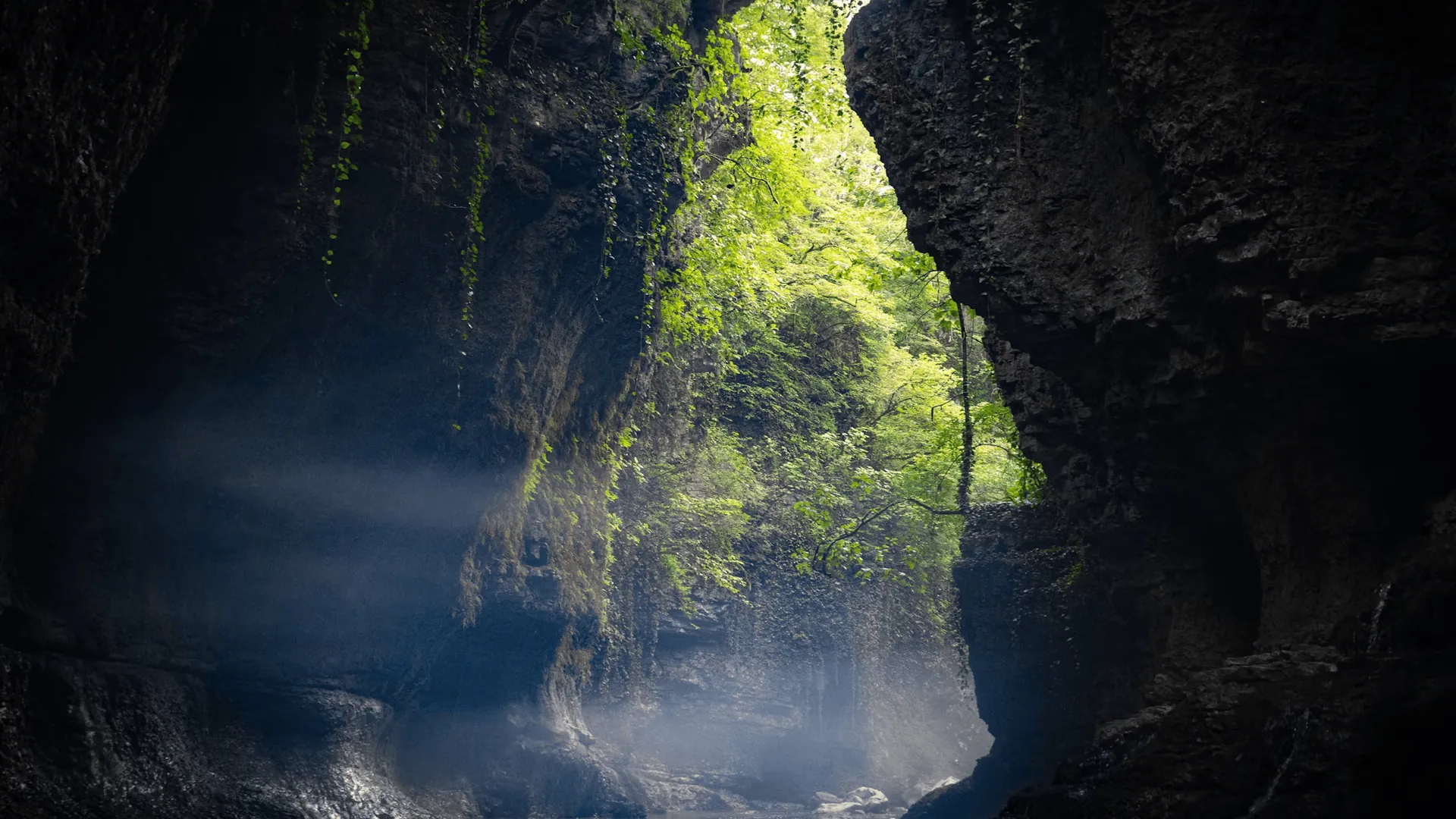
Martvili Canyon is a narrow limestone gorge carved by the Abasha River in western Georgia's Samegrelo region. Its emerald water, vertical pale walls, waterfalls, fossil traces, and old Dadiani bathing paths make it feel less like a river valley and more like a cross-section through vanished seas and royal memory.
The Abasha River enters Martvili Canyon with the calm precision of a blade. From above, the gorge looks almost too narrow to hold a river, a green ribbon pressed between limestone walls that have been opened by time, water, collapse, and pressure.
This place is also known as Gachedili Canyon or Abasha Canyon, but Martvili is the name that carries its public mythology. The gorge sits near the village of Gachedili, in the humid west of Georgia, where the Caucasus softens toward the Black Sea and the forest grows thick over stone. The water keeps a cold emerald color even when the surrounding air turns warm.
The canyon was not shaped as a scenic ornament. It is an exposed archive. Limestone beds, collapsed karst forms, fossil shells, and traces associated with ancient reptiles turn the cliffs into evidence of older worlds. In 2010, paleontological finds in the area helped push the canyon into protected status, as if the landscape had finally been recognized for what it had been quietly preserving.
Human history is layered into the rock as well. The lower canyon is linked with the Dadiani noble family, whose bath and stone trail still give the place a sense of ceremony. The old staircase and nearby mill remains make the gorge feel inhabited by gestures rather than crowds: descent, crossing, bathing, listening.
The most surreal part is the scale. Martvili Canyon is not immense in the way desert canyons are immense. Its power is intimate. A short boat passage can feel like entering a flooded cathedral where every surface is close enough to touch, but old enough to make the present feel temporary.
Interesting facts
Why is it protected as a natural monument?
The canyon combines fragile scenery with geological, paleontological, and ecological value. Protected status helps manage access while preserving the cold river corridor, limestone walls, fossils, forest, and wildlife around it.
Why does limestone make the place so sculptural?
Limestone dissolves, cracks, and collapses under water and pressure. In Martvili Canyon that behavior helped create narrow walls, natural bridges, ledges, and pale surfaces that look carved rather than merely eroded.
Why is the Dadiani name attached to the canyon?
The lower canyon is associated with the Dadiani noble family, including a bathing area and old trail. That history gives the gorge a human layer without overpowering its geological drama.
Why is the boat route so short but memorable?
The navigable section is compact, but the walls close in tightly around the river. The experience is not about distance; it is about moving slowly through stone, shadow, cold water, and reflected green light.
Why are dinosaur footprints connected with the canyon?
Paleontological work in the area found dinosaur traces and other fossils from the Late Cretaceous interval. Those discoveries helped turn the canyon from a local scenic place into a protected geological archive.
Why does the canyon feel older than the forest around it?
The forest is living on top of a much older limestone story. The exposed rocks preserve evidence of ancient marine conditions, karst collapse, and fossil-bearing layers that predate the present landscape.
Why does Martvili Canyon have several names?
The place is also known as Gachedili Canyon and Abasha Canyon. Those names point to the nearby village and to the river that carved the gorge, while Martvili is the wider municipality name most visitors recognize.
Why is the water so green?
The Abasha River runs through pale limestone and shaded canyon walls, so the water reflects mineral tones, depth, forest light, and the narrow geometry of the gorge as a cold emerald color.
Safety information
Safety information is not available yet.
Before visiting this place, check current safety guidance, access rules, local restrictions, and official updates on other trusted websites. Our editorial team does not have verified safety information for this location at the moment; it will appear here later.