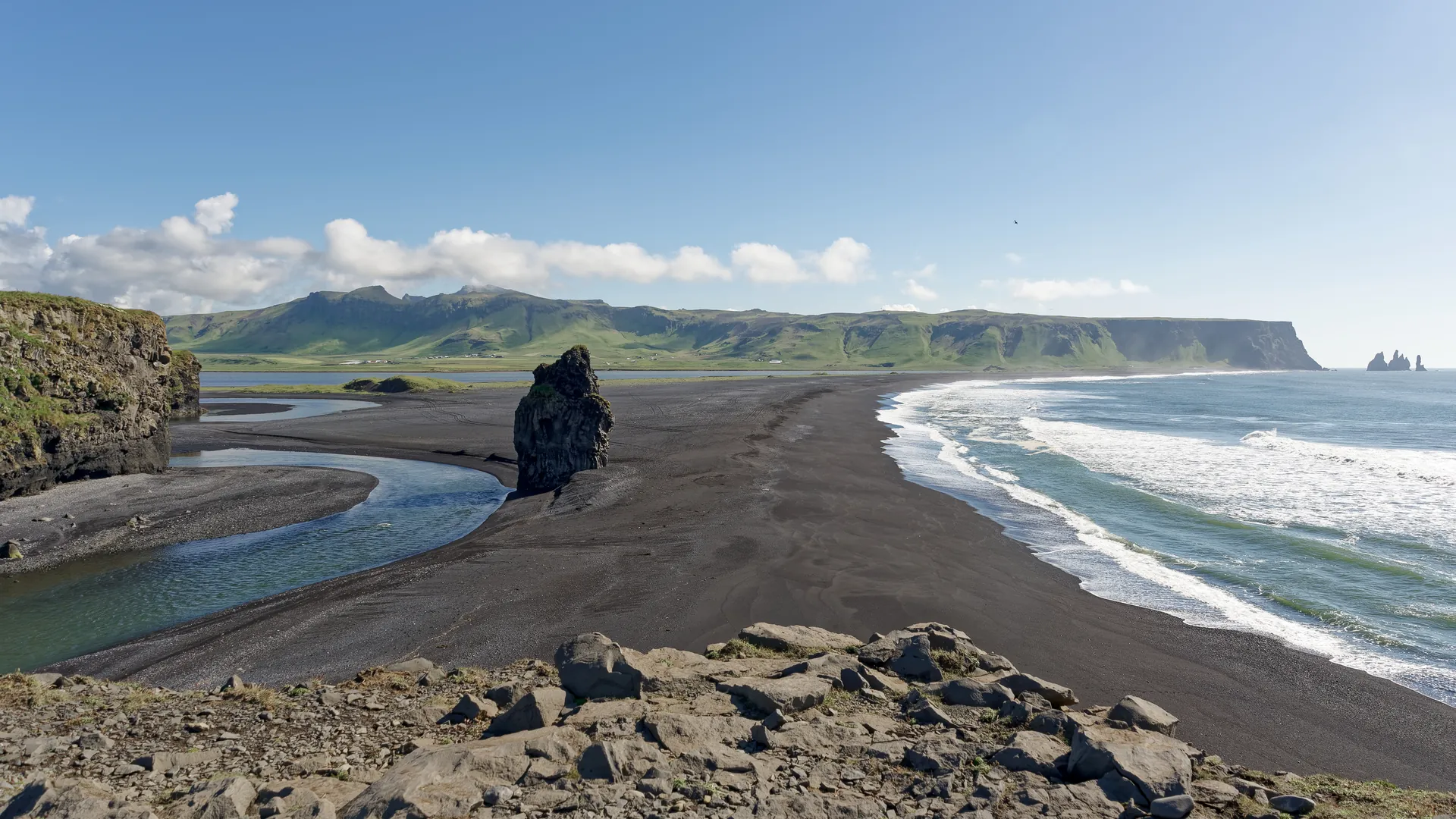
Iceland's most striking black sand beach sits beneath 66-metre basalt column formations where the North Atlantic delivers some of Europe's most dangerous surf — and in the long Arctic summer evenings, the light turns the black sand and white foam into something that looks deliberately composed.
The basalt columns of Reynisfjara began as volcanic rock intruding into the existing landscape approximately 800,000 years ago. As the lava cooled slowly, it contracted inward from the surface and cracked into hexagonal columnar forms — the same geometry that produces cracks in drying mud, the same process that built Giant's Causeway in Ireland and Fingal's Cave in Scotland. At Reynisfjara, the columns rise to 66 metres, tilted at slight angles from the vertical, stacked in configurations that resemble organ pipes or a geometric architectural drawing.
The beach in front of them is black volcanic sand — not sand in the usual sense of eroded quartz and mineral grains, but pulverised basalt, the particles dark grey and coarser than ocean beach sand. The surf here delivers the North Atlantic without interruption: there is no land between Reynisfjara and the Antarctic, and the waves arrive with all that distance behind them. The beach carries warning signs to keep clear of the water's edge; sneaker waves, unpredictable and fast, have killed people here.
To the east, the sea stacks Reynisdrangar stand in the water — three basalt pinnacles rising to 66 metres, their flanks colonised by puffins, fulmars, and guillemots in summer. Icelandic folklore identifies them as trolls caught by sunrise while trying to drag a ship to shore, petrified in the act. The figures are plausible: three forms of different heights, in postures that read as movement frozen mid-action.
In summer, the light at Reynisfjara behaves strangely. Iceland sits near enough to the Arctic Circle that in June and July the sun does not fully set — it moves along the horizon for hours, producing a light that is not day and not night but something between them, warm and horizontal, that turns the black beach and the white surf and the dark sea stacks into something that looks deliberately composed.
Safety information
Safety information is not available yet.
Before visiting this place, check current safety guidance, access rules, local restrictions, and official updates on other trusted websites. Our editorial team does not have verified safety information for this location at the moment; it will appear here later.