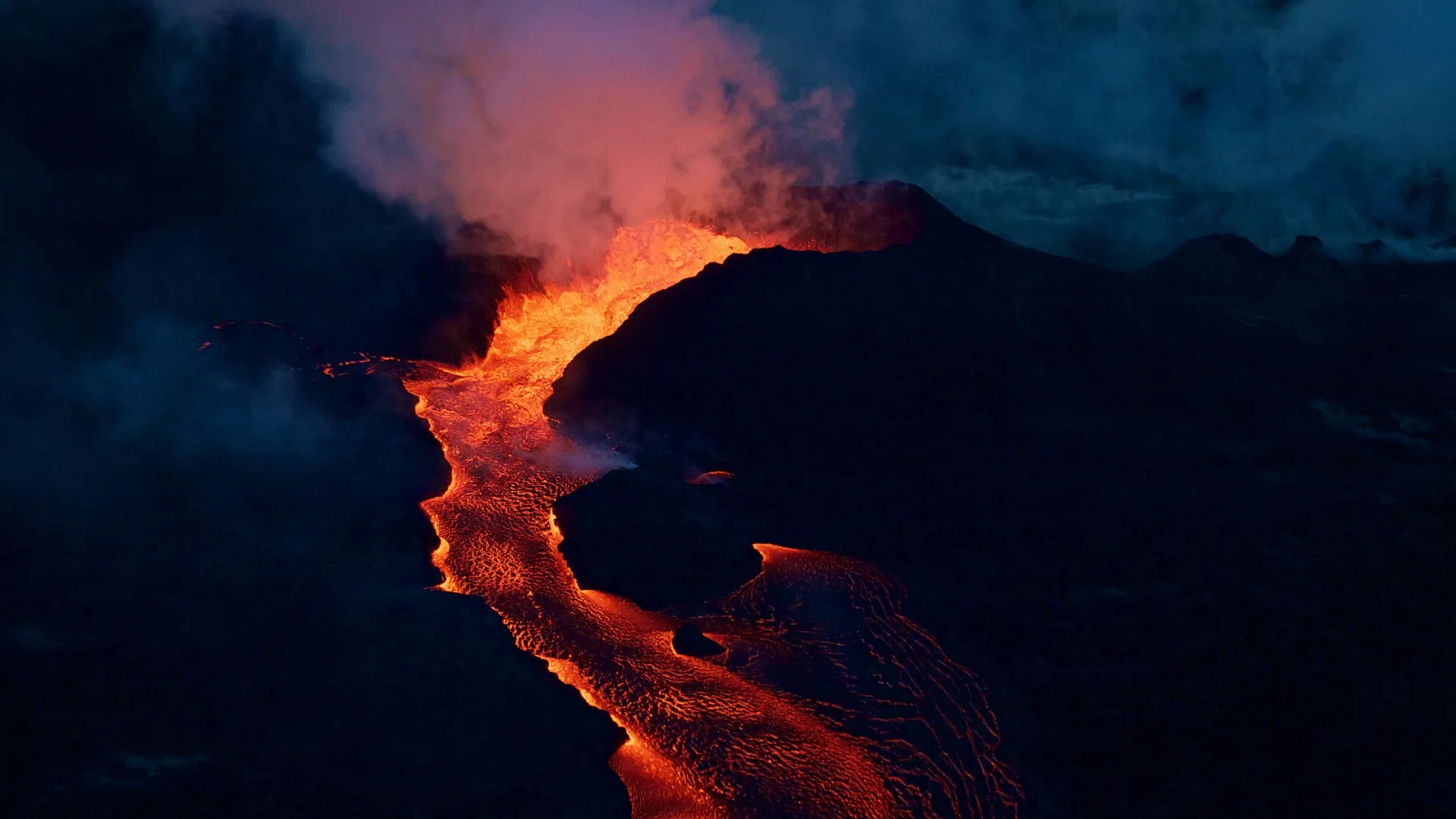
Kīlauea on Hawaii's Big Island has erupted nearly continuously since 1983 — its lava flows reaching the Pacific and solidifying into new land, adding over 875 acres to the island's coast and expanding the youngest landmass on Earth into the ocean in real time.
Kīlauea has been erupting nearly continuously since January 3, 1983 — one of the longest-running volcanic eruption sequences in recorded history. It sits on the southeastern flank of Mauna Loa on Hawaii's Big Island, and its lava flows have added more than 875 acres of new land to the island's coast since that eruption began. The lava flows to the sea, enters the water, and cools into new rock. The island is still growing.
The Hawaiian volcanic tradition understood Kīlauea as the home of Pele, the volcanic deity — specifically her current residence after a journey from her original home in the northwest. The Halemaʻumaʻu Crater at the summit was Pele's dwelling, and eruptions were understood as expressions of her presence rather than geological events. The tradition was not merely metaphorical: Kīlauea has been one of the most observable active volcanoes on Earth for millennia, and the people who lived alongside it developed a sophisticated understanding of its behaviour.
Lava from Kīlauea moves at varying speeds depending on its composition and the terrain — sometimes fast enough to outpace a walking person, sometimes slow enough that it moves at the speed of setting concrete. Where it enters the forest, the trees explode from steam generated by the approaching heat. Where it reaches the coast, it meets the ocean in plumes of steam and hydrochloric acid, hissing and cracking as it solidifies into shapes unlike ocean rock anywhere else — ropy pahoehoe, jagged aa, pillared lava deltas extending into the sea.
The landscape around an active Kīlauea flow is the newest surface on Earth. The black rock underfoot may be days or weeks old. Walking across it, you are walking across something that did not exist until recently, and the ocean receiving the new additions is indifferent to the scale of what is happening.
Safety information
Safety information is not available yet.
Before visiting this place, check current safety guidance, access rules, local restrictions, and official updates on other trusted websites. Our editorial team does not have verified safety information for this location at the moment; it will appear here later.