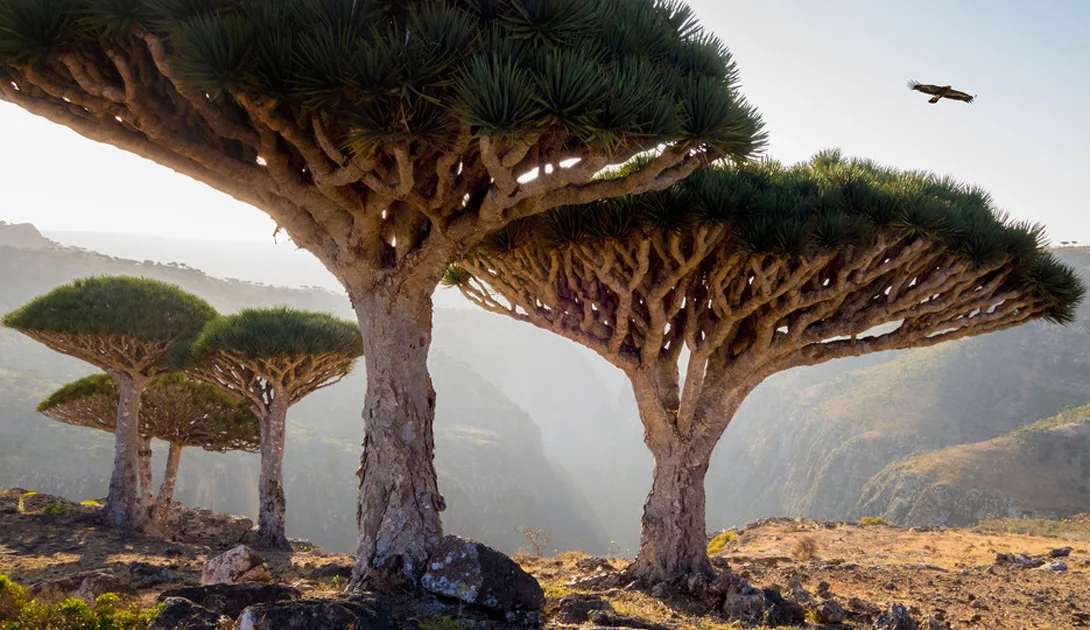
Isolated from mainland Africa for 6–7 million years, Socotra developed 825 species found nowhere else — including the Dragon Blood Tree, whose canopy resembles an inside-out umbrella and bleeds deep crimson resin.
Socotra was isolated from mainland Africa for 6 to 7 million years. In geological terms, 6 million years is a recent separation — approximately the time since humans and chimpanzees diverged from a common ancestor. But evolutionary isolation on an island with Socotra's variety of habitats — coastal limestone, granite mountains reaching 1,500 meters, inland desert, perennial fog zones — produces biological divergence at a rate that isolation compounds over generations. The result is 825 plant species found nowhere else on Earth, representing 37% of the island's total flora. No other island of comparable size has this degree of botanical endemism outside oceanic archipelagos. Socotra is, in botanical terms, one of the most alien places on the planet's surface.
The Dragon Blood Tree (Dracaena cinnabari) is the island's emblem and most internationally recognized species. Its appearance is genuinely unlike any other tree: a dense, flat plateau of dark green leaves balanced above a canopy of forking branches that emerge from a thick single trunk, creating a form that looks less like a tree and more like a diagram of a tree — the idea of a tree, rendered in a style no evolutionary process elsewhere has chosen. When cut, the trunk bleeds a deep crimson resin that was traded across the ancient world as a pigment, adhesive, medicine, and varnish. Dragon blood resin appears in Egyptian embalming compounds, Roman cosmetics, Renaissance oil paintings, and Indian Ayurvedic medicine. The tree that produces it looks like it was designed for exactly this purpose.
The island was known to ancient Phoenician, Greek, Arab, and Indian traders as a source of exotic biological products — dragon blood, aloe vera, frankincense, civet. Arab geographers called it the Island of Bliss. The isolation that produced its extraordinary biology also made it a stopping point for long-distance trade routes across the Indian Ocean. Marco Polo described it. Arab merchants established the trading culture that still characterizes the island's economy. The current Socotri language — spoken by approximately 70,000 people and written only recently — is a South Semitic language with no close living relatives, as isolated in linguistic terms as the island's biology.
The limestone plateau and granite highland landscapes beyond the famous trees are equally distinct. Wind-sculpted stone formations in the Homhil Plateau, fog-watered woodland on the Haggeher mountains, beach-side frankincense groves along the north coast — the island accumulates ecological strangeness at every scale. Some coastal limestone areas support formations that look architectural: eroded pillars, arches, and caves in pale rock above turquoise water. The combination of extraordinary botany and geological spectacle in a small island area — approximately 3,600 square kilometers — is not replicated anywhere else.
The political situation in Yemen, of which Socotra is a governorate, creates ongoing access uncertainty. The island was largely insulated from the Yemeni civil war by its geography, but administrative control and the provision of services have been contested and disrupted repeatedly. Flights operate primarily from Abu Dhabi and Sana'a. The limited infrastructure on the island — few paved roads, limited accommodation — means that visiting Socotra requires tolerance for conditions that most international tourism does not prepare visitors for. This is also, incidentally, why the island has remained as extraordinary as it is.
Safety information
Safety information is not available yet.
Before visiting this place, check current safety guidance, access rules, local restrictions, and official updates on other trusted websites. Our editorial team does not have verified safety information for this location at the moment; it will appear here later.