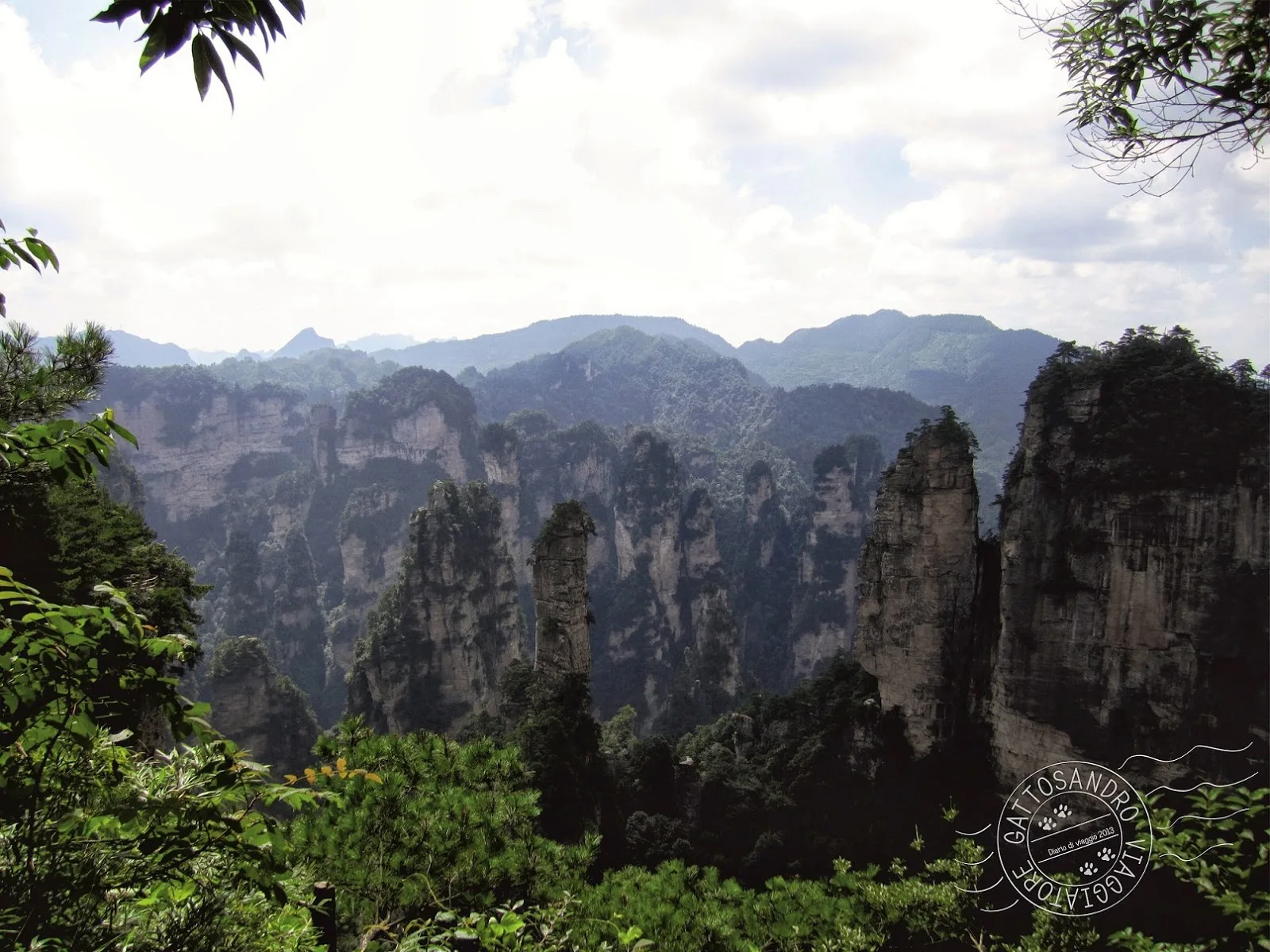
Thousands of sandstone pillars rise vertically from subtropical jungle, wreathed in mist — so alien that James Cameron used them as reference for the floating mountains of Pandora in Avatar.
For 300 million years, quartz sandstone eroded away at the margins of what is now Hunan Province, leaving behind more than 3,000 quartzite pillars and peaks jutting from a sea of subtropical forest. Some rise over 200 meters from the valley floor. The tallest, Southern Sky Column, tops 1,080 meters. The process that created them is called differential erosion: harder rock resists weathering longer, and what remains when everything softer has been removed are these near-vertical formations, each one a survivor. The jungle has grown back around them, draped in ferns and hanging moss, threading between the columns at every level with a density that makes the stone appear to emerge from living material rather than from the earth below.
James Cameron's production designers walked the Zhangjiajie paths in 2008 during the development of Avatar. What they found — the proportions, the near-impossible verticality, the relationship between stone and suspended mist, the quality of light at low cloud level — translated directly into the Hallelujah Mountains of Pandora. Cameron confirmed the reference publicly after the film's release. The local Tujia people had been living among these formations for millennia, calling them tiān zhù — heavenly pillars — without needing the framing of science fiction to articulate what the landscape implied.
In the mornings, when low cloud fills the valley floors between pillars, each formation appears to float independently. The effect is architectural in the most disorienting sense: it reads as if something built these towers and then the scaffold was removed, leaving only the columns standing, 200 meters tall, in air. At higher cloud, the formations disappear and reemerge as the mist moves through them. The viewing experience is never static for more than a few minutes. Zhangjiajie does not present a fixed panorama. It presents a moving one.
Zhangjiajie National Forest Park was established in 1982 as China's first national forest park, and the broader Wulingyuan Scenic Area was inscribed as a UNESCO World Heritage Site in 1992. The area includes the park itself plus three adjacent scenic zones — Suoxi Valley, Tianzi Mountain, and Yangjiajie — covering approximately 264 square kilometers of quartzite pillar and peak landscape. The Tianmen Mountain cable car, at 7.5 kilometers the world's longest single-track aerial tramway, provides access to the 1,500-meter plateau above the main valley.
Crowds in peak season (April–October, Chinese national holidays) are substantial, and the primary trails and cable car lines involve genuine queuing. The photographic and experiential reward is highest in the early mornings of autumn and spring, when mist is most frequent, temperatures are moderate, and the overnight visitors who have stayed in the park itself have the primary viewing times to themselves before the day-trip crowds arrive from Zhangjiajie city. The stone does not change. The relationship between stone and cloud changes constantly.
Interesting facts
Why do locals call this area the first wonder under heaven?
The phrase predates the Avatar comparison by centuries. Tang dynasty poets visiting the area described the formations as something impossible — mountains that had escaped from the sky. The region had mythological status in Chinese culture long before modern tourism discovered it.
Why does Tianmen Mountain have a natural arch large enough to fly a plane through?
Tianmen Cave is a limestone arch 131 meters high and 57 meters wide, formed when the mountain face collapsed inward thousands of years ago. In 1999, a stunt pilot flew a jet aircraft through it — the first time a fixed-wing plane passed through a natural mountain opening.
Why is the cable car here one of the longest in the world?
The Tianmen Mountain cable car runs 7.5 kilometers up a vertical rise of over 1,200 meters — the longest single-stage passenger cable car on Earth. It was built because the terrain is too extreme for a road to follow the same route.
Why are there more than 3,000 pillars in such a small area?
The entire park was once a flat sandstone plateau. Water infiltrated vertical joints in the rock over hundreds of millions of years, dissolving and washing away everything between the harder blocks and leaving behind a dense field of isolated towers.
Why does the landscape look different in every season?
Fog fills the valleys in spring, turning the pillars into islands above white cloud. Summer brings dense subtropical foliage. Autumn strips the trees to amber and red. Winter occasionally dusts the peaks in snow while mist thickens below, making the columns look like ink paintings.
Why is the glass bridge here the most terrifying in the world?
The Zhangjiajie Grand Canyon Glass Bridge spans 430 meters between two cliffs and sits 300 meters above the canyon floor. Its transparent deck gives an unobstructed view straight down, and the bridge sways slightly in wind — a deliberate design choice to keep crossings memorable.
Why is the park home to species found nowhere else on Earth?
The vertical terrain creates dozens of isolated micro-climates within a few kilometers. Species trapped on different columns or in different valleys evolved separately for millions of years, producing endemic plants, amphibians, and insects unique to this area of Hunan province.
Why do the columns stay standing despite looking impossibly thin?
The pillars are made of quartz sandstone that is exceptionally dense and resistant to erosion. Over 300 million years of water, frost, and root action widened the cracks between them without weakening the stone itself, leaving narrow spires that are structurally stable.
Why did Avatar use these mountains as a direct reference?
Director James Cameron and production designer Robert Stromberg visited Zhangjiajie specifically to study its formations. The Hallelujah Mountain in Avatar is modeled almost exactly on the Yellow Stone pillar, which was officially renamed "Avatar Hallelujah Mountain" after the film released.
Why do the pillars look like they are floating in the sky?
The sandstone columns are so tall and narrow — some over 200 meters high — that clouds and mist regularly wrap around their bases, cutting them off from the ground. From a distance, the tops appear to hover in open air.
Safety information
Safety information is not available yet.
Before visiting this place, check current safety guidance, access rules, local restrictions, and official updates on other trusted websites. Our editorial team does not have verified safety information for this location at the moment; it will appear here later.