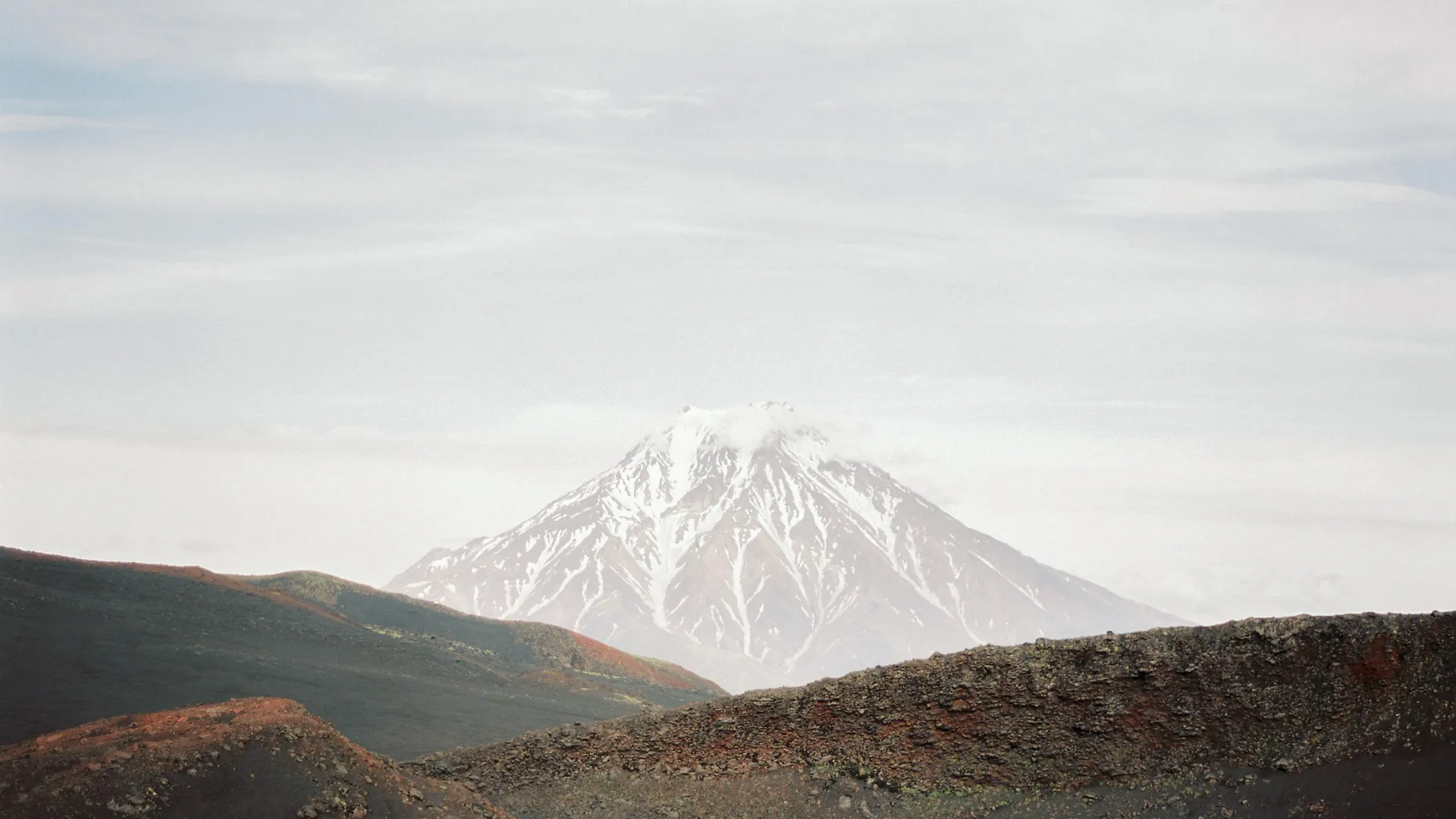
A shield volcano on the remote Kamchatka Peninsula whose eruptions paint the tundra in rivers of black basalt and crimson lava — one of the most active and visually overwhelming volcanoes on Earth.
Tolbachik is not one volcano. It is a volcanic field — two stratovolcanoes and hundreds of cinder cones spread across 40 kilometers of the Kamchatka Peninsula's central spine, continuously active, reshaping the landscape around it on a timescale that makes it unusual among the world's accessible volcanic sites. The two main peaks, Ostry Tolbachik (3,682 m) and Plosky Tolbachik (3,140 m), form a massif that has been accumulating erupted material for approximately 10,000 years. The cinder cone field that surrounds them — hundreds of subsidiary vents, lava shields, and scoria deposits — gives the broader area the appearance of a geologically recent destruction that has not yet been covered by vegetation or time.
In some areas, it hasn't been. The 1975–76 Great Tolbachik Fissure Eruption was one of the largest basaltic eruptions of the 20th century — 18 months of activity that produced approximately 2.2 cubic kilometers of eruptive material, buried 40 square kilometers under lava flows, and built four new cinder cones, the largest reaching 340 meters height. The Soviet scientific monitoring program present during the eruption produced some of the most detailed documentation of a large-scale effusive eruption in the historical record. The lava field from 1975-76 is still largely unvegetated — a black, sharp-edged basaltic landscape that photographs as another planet and underfoot behaves exactly as sharp young lava should. A second significant eruption occurred in 2012–13, adding new lava flows adjacent to the older ones. The two eruption fields are distinguishable by vegetation status: the 1975-76 flows are acquiring sparse lichen cover; the 2012-13 flows have almost none.
The mineralogy of Tolbachik's eruptions is unusual. The basalts contain elevated concentrations of unusual mineral phases — the Tolbachik field has yielded more than 130 new mineral species described nowhere else on Earth, many found in the fumarolic deposits around active vents. Some of these minerals form in the intense chemical environment of the fumaroles and have been found in crystalline form on cooled lava surfaces — vivid blues, greens, and yellows from copper, sulfur, and chloride compounds precipitating as gases cool against the rock surface. This mineralogical richness has made Tolbachik a destination for geologists studying volcanic mineralogy alongside the standard volcanological interest in eruption dynamics.
The Kamchatka Peninsula was a closed military zone during the Soviet period, accessible to foreigners only after 1990. The combination of this access history and the genuine remoteness of the peninsula — it can only be reached from mainland Russia by air or sea — means that Tolbachik receives far fewer international visitors than its geological significance warrants. The nearest settlement with infrastructure is Kozyrevsk, accessible by road from Petropavlovsk-Kamchatsky (the peninsula's main city) in approximately 5 hours. From Kozyrevsk, access to the cinder cone field and lava flows requires 4WD vehicles and, for the upper massif, mountain equipment.
The lava field at night, with a cloudless sky above the peninsula and the entire Kamchatka skyline visible, is an environment that reads as entirely off-planet — black basalt in every direction, no vegetation, volcanic gas hissing from fumaroles in the distance, and above it a sky dark enough to show the full disc of the Milky Way. Soviet-era geologists camped on this field for 18 months documenting the 1975 eruption. The equipment they left is still there, preserved in the dry, cold Kamchatka air.
Safety information
Safety information is not available yet.
Before visiting this place, check current safety guidance, access rules, local restrictions, and official updates on other trusted websites. Our editorial team does not have verified safety information for this location at the moment; it will appear here later.