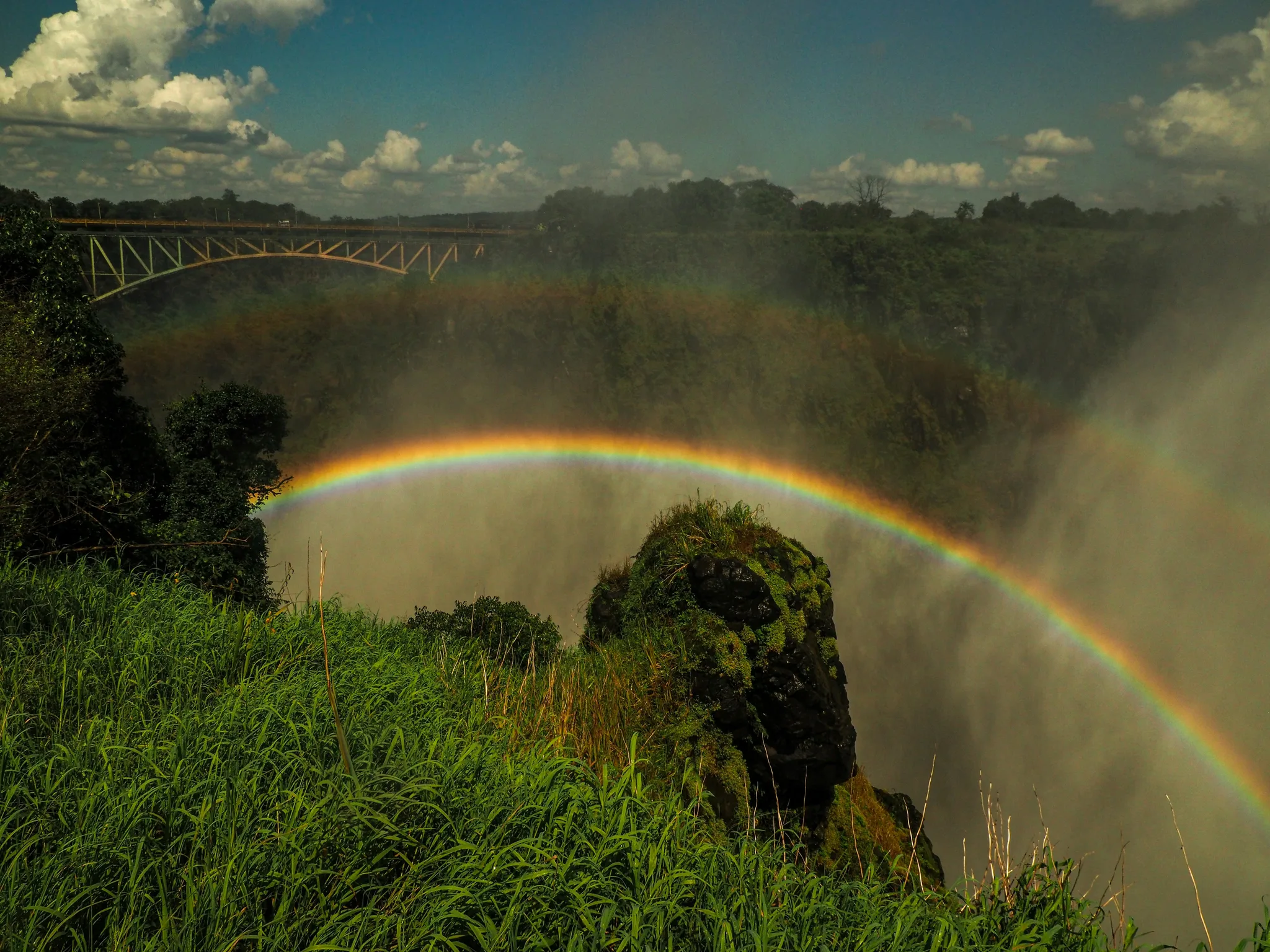
The world's largest waterfall by combined width and height — the spray column rises 400 meters and can be seen from 50 kilometers away, creating permanent rainbows visible both day and night under a full moon.
The Kololo tribe called it Mosi-oa-Tunya — the smoke that thunders. The name is the right one. The sound of Victoria Falls arrives long before the falls are visible: a low, sustained percussion that increases in volume until, rounding the final bend of the spray-forest path on the Zimbabwean bank, you are confronted simultaneously with the noise, the mist rising 400 meters into the air, and the sight of the Zambezi River disappearing over a basalt cliff 1.7 kilometers wide. The experience does not build gradually. It arrives all at once.
Victoria Falls is not the world's tallest waterfall, or the widest. It holds the superlative for combined width and height — a 108-meter drop across a 1.7-kilometer span. At peak flow between February and May, the Zambezi delivers approximately 500,000 cubic meters of water per minute over the cliff, into the 80-meter-wide gorge below. The spray column rises 400 meters and is visible as a white plume from 50 kilometers away across the Zambian plain. The mist that doesn't rise falls back as rain on both banks, sustaining a 75-meter-wide strip of dense rainforest on each side — forest that exists nowhere else in the world in this configuration, watered entirely by the spray of a single waterfall.
The rainbows are structural. A primary rainbow hangs in the mist on most clear afternoons, positioned by the sun angle and water vapor with the reliability of a tide. On full moon nights, the moonlight is bright enough to produce a lunar rainbow — a moonbow — in the spray rising from the gorge. The moonbow appears white or faintly silver to the naked eye, because human color perception requires more light than moonlight provides, but long-exposure photographs reveal the full spectral order. David Livingstone, who became the first European to document the falls in November 1855, wrote in his journal: scenes so lovely must have been gazed upon by angels in their flight. He added, with more honesty, that no description could convey an adequate idea of the beauty. He was right about both.
The falls straddle the border between Zambia and Zimbabwe and can be viewed from both sides. The Zimbabwean bank offers the most complete frontal view of the full curtain of water. The Zambian side gives closer access to the main falls and — during the low-water season from September to December — access to Devil's Pool, a natural rock enclosure at the very lip of the falls where the reduced flow makes swimming to the edge survivable. Swimming to the edge of a 108-meter waterfall, held by a submerged rock rim and a rope, with the gorge visible 100 meters below, is not a comfortable experience in any conventional sense. It is, however, an experience that a significant number of people travel a long distance to have.
The Toka-Leya people who have lived near the falls for centuries understood Mosi-oa-Tunya as a sacred site — a threshold where the spirit world was accessible, where the spray forest on the rim was a place of retreat and prayer. The spray forest on the Zimbabwean bank remains largely intact, one of the few old-growth forest remnants in southern Africa, sustained by an ecosystem that depends on a waterfall that has been running without interruption since before human memory began here.
Safety information
Safety information is not available yet.
Before visiting this place, check current safety guidance, access rules, local restrictions, and official updates on other trusted websites. Our editorial team does not have verified safety information for this location at the moment; it will appear here later.