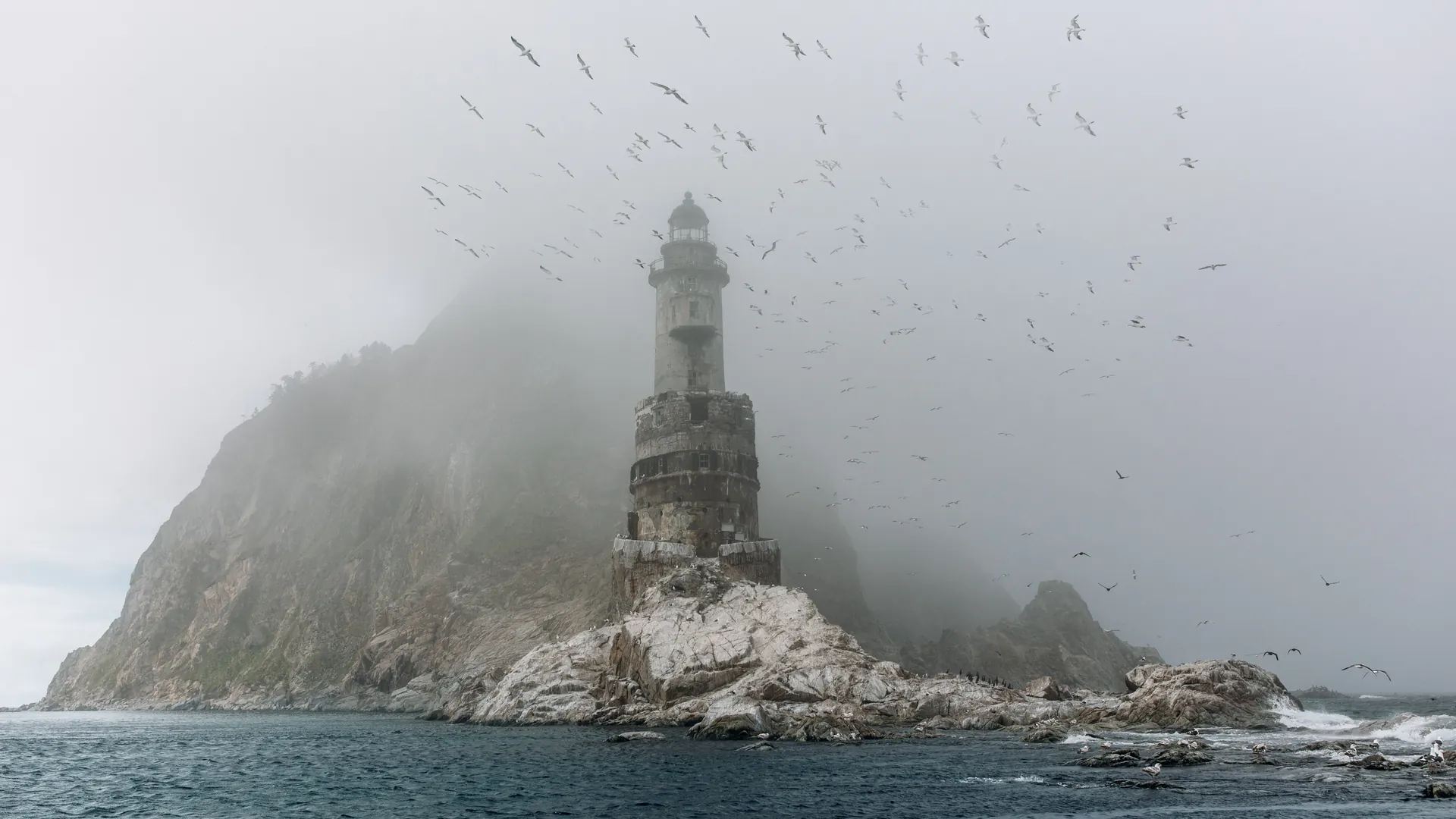
A 31-meter concrete lighthouse rising straight out of Sivuchya Rock, a wave-battered islet just off Cape Aniva at the southern tip of Sakhalin Island. Built by Japanese engineers between 1937 and 1939, it ran on nuclear isotope power from 1990 until its radioactive core was removed in 2006 — since then it has stood empty, unreachable except by boat, slowly losing pieces of itself to the sea.
There is no road to Aniva Lighthouse. There never really was. The structure sits on Sivuchya Rock — "Sea Lion Rock" — a jagged outcrop a short but often violent boat ride from the tip of Cape Aniva, the southernmost point of Sakhalin Island in Russia's Far East. Fog rolls through the strait for much of the year, the current runs hard, and even a calm-looking sea can turn a landing into something dangerous within minutes. That isolation is precisely why the lighthouse needed to exist in the first place, and precisely why it now sits abandoned.
Japan controlled the southern half of Sakhalin — a territory called Karafuto — from 1905 until the end of the Second World War, and it was Japanese engineers, led by Miura Shinobu, who finally solved the problem of lighting this stretch of water. A shipwreck in 1898 had already proven how dangerous the cape was, but building anything on Sivuchya Rock was considered nearly impossible until construction began in earnest in 1937. Workers blasted and reinforced the rock itself, then raised a round concrete tower on top of it — six stories, a light 40 meters above sea level, a fog signal, generator rooms, and living quarters for a small keeper's crew, all packed into a structure barely wider than the rock beneath it. It took a little over two years and roughly 600,000 yen, and by the time it switched on in 1939 its beam could reach 28 kilometers out to sea.
After 1945, the lighthouse passed to Soviet, then Russian, control, and kept working largely unchanged for decades — keepers rotated in and out by boat, supplies hauled up by crane, life on a rock with no ground to walk on beyond the tower's own foundations. In 1990, in a decision typical of the era's approach to remote Soviet infrastructure, the diesel generators were replaced with a radioisotope thermoelectric generator, letting the light run unattended and automated for years at a stretch without anyone needing to make the crossing at all.
That automation bought Aniva Lighthouse another sixteen years of operation — and then, in 2006, its purpose. The isotope power unit was removed for safety and disposal, no replacement power source was installed, and the light went dark for good. Everything of value was stripped out. What's left is a hollow concrete shell: broken windows, rusted railings, walls stained by decades of salt spray, and thousands of seabirds that have claimed the ledges and empty rooms as their own rookery.
Photographs of Aniva Lighthouse have circulated for years as a stand-in for "the loneliest place on Earth" — usually shot from a boat in flat gray light, the tower rising out of the rock like something that grew there rather than something built. It's not an exaggeration so much as an accurate description of what the structure actually is: a fully engineered, occupied, functioning piece of maritime infrastructure that was deliberately placed as far from solid ground as its builders could manage, and has now been left to find out what happens to concrete and steel when the sea gets seventy years alone with them.
Safety information
Aniva Lighthouse can usually be visited only by sea with organized boat tours, but landing at the lighthouse may be restricted or prohibited due to safety and reconstruction concerns.
Why this guidance exists
Recommended actions
- Do not attempt to visit independently or by unlicensed boat
- Use a reputable local operator with proper safety equipment and marine experience
- Confirm before departure whether landing at the lighthouse is currently allowed or prohibited
- Expect the route, timing, or cancellation to depend on sea and weather conditions
- Wear a life jacket during the boat crossing and follow the captain's instructions
- Bring warm windproof clothing, waterproof outerwear, hat, and suitable footwear
- Carry personal medication and notify the operator about allergies or chronic conditions
- Carry passport or identity documents in case they are required by local authorities
- Avoid visiting in fog, strong wind, rough sea, storms, or poor visibility
- Do not climb unstable structures, wet rocks, or damaged parts of the lighthouse
- Stay away from cliff edges, bird nesting areas, and slippery coastal rocks
- Prepare for limited mobile signal, difficult evacuation, and a long return route