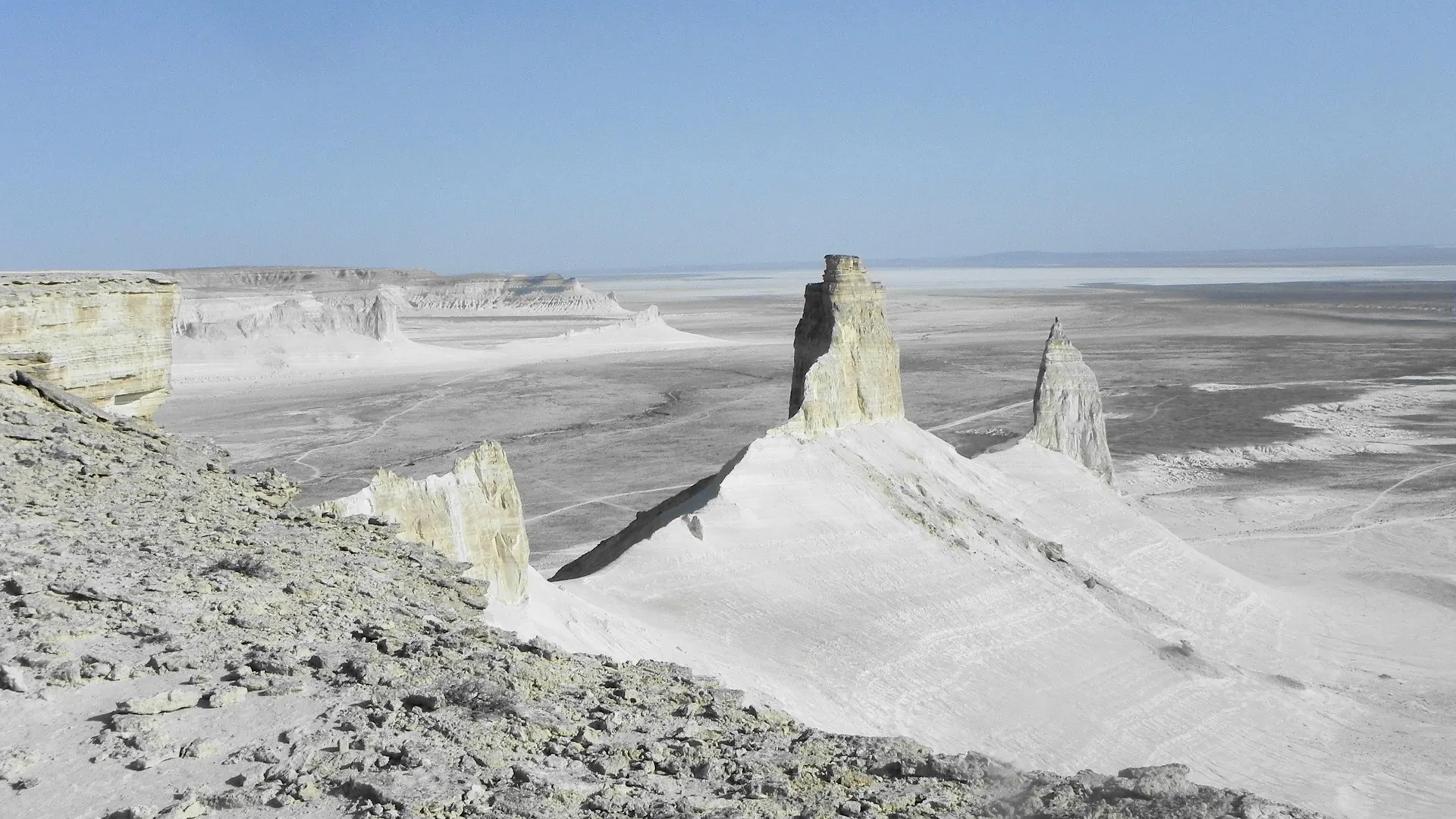
A vast basin of white chalk cliffs, mesas, and twin rock spires carved into the edge of the Ustyurt Plateau in western Kazakhstan's Mangystau region. Roughly 250 million years ago this entire landscape sat at the bottom of the Tethys Ocean — the pale rock underfoot is compressed seabed, still packed with marine fossils, now standing dry and cracked under a desert sky.
From the rim of the plateau, Bozzhyra doesn't look like it belongs on the same planet as the steppe around it. The ground simply drops away into a bleached, layered basin of chalk and limestone, stretching toward two narrow spires known locally as "the fangs" — twin towers rising more than 200 meters from the canyon floor, sharp enough that they're the single most photographed formation in all of western Kazakhstan.
The story of how this place came to exist is written directly into the rock. Around 250 million years ago, during the Permian and Triassic periods, the entire Mangystau region lay submerged under the Tethys Ocean, the vast body of water that once separated the ancient supercontinents of Laurasia and Gondwana. Marine sediment settled and compressed for millions of years into thick beds of chalk and limestone. When the Tethys eventually retreated as tectonic plates shifted, it left behind a seabed hundreds of meters thick — which wind, flash floods, and temperature swings have spent the millennia since carving into cliffs, mesas, and the canyon system now called Bozzhyra.
Locals in the nearby villages have long called the wider plateau "Ustyurt" — roughly "land of hills" in Old Turkic — but Bozzhyra itself carries its own name, translated loosely as "gray ravine." The valley spans some 3,000 square kilometers, though the most dramatic scenery concentrates in a much smaller stretch near three informal viewpoints that guides have nicknamed the Martian Panorama, the Dragon's Crest, and the Fangs. None of the names are official. There's no visitor center, no paved trail system, no fencing at the cliff edges — just tire tracks in the chalk dust left by the 4x4 vehicles that are, for now, the only practical way in.
That isolation is part of what keeps Bozzhyra out of the conversation that surrounds better-known badlands elsewhere in the world. It gets compared often to Arizona's Monument Valley, and the comparison holds up in silhouette — mesas, spires, a horizon broken into geometric fragments — but Bozzhyra sees a fraction of the visitors, requires no permits, and costs a fraction as much to reach if you're already anywhere near Central Asia. The trade-off is that you're on your own: 270 kilometers of driving from Aktau, much of it on rough tracks with no cell signal, no shade, and summer heat that regularly clears 40°C.
What makes Bozzhyra feel less like a canyon and more like a fossil of an entire ocean is the constant reminder underfoot: shells and marine fragments embedded directly in the chalk, visible without digging. Standing at the base of the fangs, looking up at rock that once had a few hundred meters of seawater sitting on top of it, the desert silence starts to feel less like emptiness and more like the after-effect of something enormous draining away.
Safety information
Bozzhyra Valley is a remote desert landscape on the Ustyurt Plateau. Visiting requires a capable 4x4 vehicle, desert preparation, local route knowledge, and current access checks.
Why this guidance exists
Recommended actions
- Do not visit in a regular car; use a high-clearance 4x4 vehicle suitable for desert tracks
- Use an experienced local guide or driver familiar with Mangystau routes
- Check current access rules, protected-area requirements, and possible permit needs before departure
- Carry extra drinking water, food, fuel, spare tire, recovery gear, first-aid kit, and offline maps
- Do not rely on mobile signal for navigation or emergency communication
- Avoid visiting during extreme heat, heavy rain, storms, strong wind, or poor visibility
- Stay away from cliff edges, unstable slopes, soft ground, and eroded rock ledges
- Do not drive off established tracks or damage fragile desert surfaces and chalk formations
- Plan the route, fuel stops, and return time in advance
- Avoid solo travel and inform someone of your planned route and expected return time
- Wear sun protection, sturdy footwear, and clothing suitable for desert wind and temperature changes
- Pack out all trash and avoid disturbing the protected desert environment
Sources
- https://www.advantour.com/kazakhstan/mangystau/bozzhyra.htm
- https://www.orexca.com/kazakhstan/mangystau/bozzhyra.htm
- https://astanatimes.com/2023/07/short-guide-to-visit-bozzhyra-gorge-in-mangystau-region/
- https://qazinform.com/news/top-tourist-places-in-kazakhstan-mangistau-region-d988d2
- https://www.gov.kz/memleket/entities/mangystau-tourism?lang=en