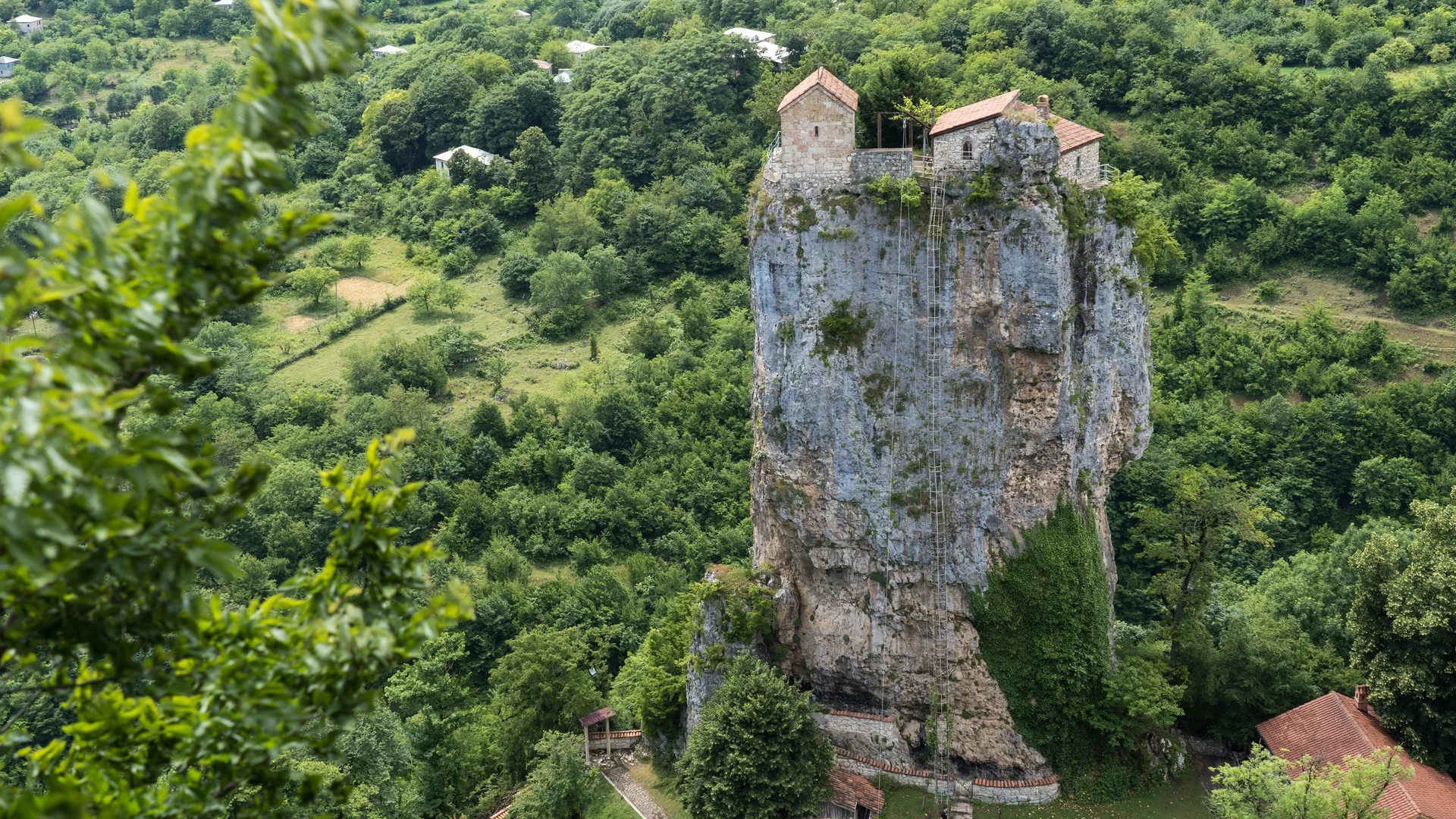
A freestanding natural limestone tower rises 40 meters straight out of a river valley in western Georgia, its narrow summit crowned by a functioning Orthodox church. Since 1995 a single monk has lived up there in near-total isolation, reachable only by a steel ladder bolted to the rock face — and since 2012, that ladder has been off-limits to everyone but him.
From the valley floor it looks like a special effect: a bare column of rock, roughly the height of a 13-story building, standing completely alone against the tree line of the Kvirila river gorge. No ridge connects it to anything. It simply rises out of the ground near the village of Katskhi in Imereti, western Georgia, as if a slice of a mountain had been left behind when everything around it eroded away — which, geologically, is close to what actually happened.
People have been climbing this thing for a very long time. Excavations on the summit uncovered the remains of a hermitage dating to the 9th or 10th century, and in 2007 archaeologists found a carved limestone plate from the 13th century naming a builder called Giorgi, responsible for three hermit cells cut into the rock. For medieval ascetics, physical distance from the ground was the whole point — a stone pillar with no easy way up was as close as you could get to renouncing the world without leaving Earth entirely. The tradition has a name: stylitism, after the pillar-dwelling saints of early Christianity, and Katskhi may be its most literal surviving expression.
The monastery fell silent for centuries, its cells reclaimed by weather and birds, until 1995, when a monk named Maxim Kavtaradze — a native of the nearby town of Chiatura — began climbing the rock and living there in solitude. Restoration work between 2005 and 2009, backed by Georgia's National Agency for Cultural Heritage Preservation, rebuilt the small church dedicated to Maximus the Confessor, a crypt, a wine cellar, and the hermit cells on the roughly 150-square-meter summit. An iron ladder was fixed to the cliff face so the monk could descend for supplies and return to his solitude.
For a while, visitors — men only, per Orthodox tradition for this site — could climb that ladder themselves. That ended in 2012, when the church closed the ascent to the public for safety reasons, leaving the summit accessible to essentially one person. Everyone else experiences Katskhi Pillar the way medieval villagers always did: by looking up.
What makes the place feel less like a tourist attraction and more like an idea made physical is the total absence of compromise in it. There's no funicular, no viewing platform bolted halfway up, no easy version of the pilgrimage. The isolation isn't a design flourish — it's the entire reason the structure exists, chosen deliberately by people who wanted exactly the kind of confinement that a 40-meter vertical rock provides. Standing in the gorge below, watching a thin plume of smoke rise from a chimney on top of an unclimbable tower, it's hard not to wonder what it does to a person's sense of time to live somewhere the rest of the world can only visit with binoculars.
Safety information
Katskhi Pillar can be viewed from the ground, but visitors are not allowed to climb to the monastery on top of the pillar.
Why this guidance exists
Recommended actions
- Visit only the lower viewpoint and areas open to the public
- Do not attempt to climb the pillar or use the ladder without explicit local permission
- Respect the monastery, monks, religious signs, and any posted visitor rules
- Dress modestly and avoid loud behavior near the religious site
- Wear suitable shoes for uneven or steep paths around the viewpoint
- Avoid approaching steep edges, loose rock, or wet/slippery slopes
- Check local conditions before visiting, especially after rain or in winter
- Use a local guide if you need context or want to avoid misunderstanding access rules
- Do not fly drones, photograph restricted areas, or enter religious spaces if prohibited
- Treat online claims about climbing access as potentially outdated and verify locally
Sources
- https://en.wikipedia.org/wiki/Katskhi_Pillar
- https://edition.cnn.com/travel/article/katskhi-pillar-georgia
- https://kutaisi.travel/en/5645/katskhi-pillar-en/
- https://www.advantour.com/georgia/chiatura/katskhi-pillar.htm
- https://georgiantravelguide.com/en/the-katskhi-pillar
- https://georgia.to/en/places-to-go/imereti/katskhi-pillar/