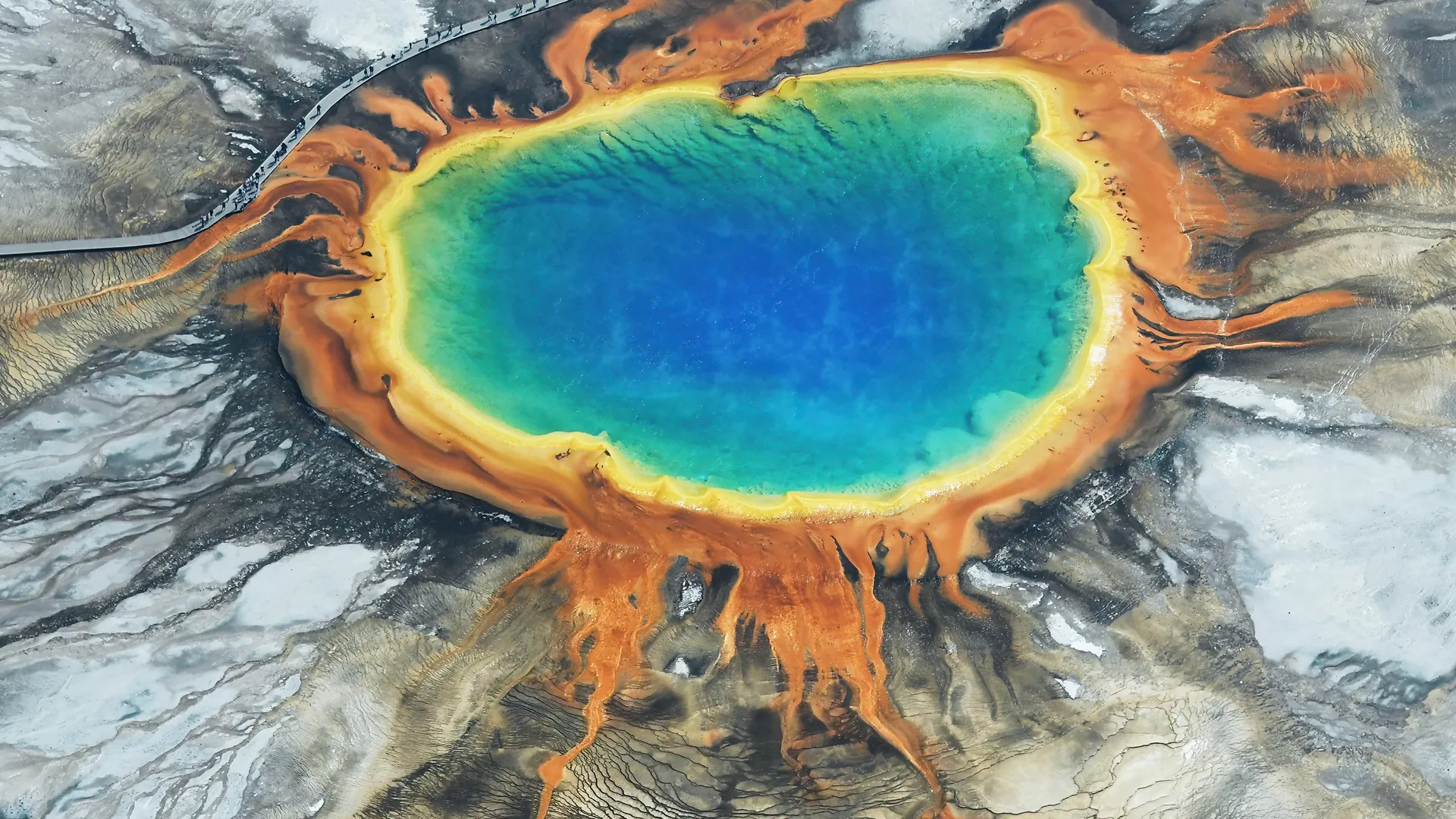
The largest hot spring in the United States and the third largest in the world, ringed by concentric bands of red, orange, yellow and green that surround a core of impossible sapphire blue. The colors are not mineral but alive — heat-loving microbial mats, each species holding its own narrow temperature band, arranged by the water itself into rings as precise as a target.
From the air, Grand Prismatic Spring looks less like a geological feature than a deliberate act of design: a perfect blue eye set inside rings of amber, gold, and rust, steaming quietly in a lodgepole pine forest in the middle of Wyoming. Nothing about the shape suggests accident. It is 110 meters across and 50 meters deep, hot enough at its center to sterilize anything that touches it, and it is that sterility — not pigment, not mineral deposit — that produces the blue. Pure water scatters light toward the blue end of the spectrum, and at Grand Prismatic's boiling core, nothing lives to muddy the effect.
Move outward from the center and the water cools, degree by degree, and an entirely different explanation takes over. The rings of orange and yellow and green are colonies of thermophilic bacteria and archaea, organisms that evolved to thrive in conditions that kill nearly everything else, each species occupying the precise temperature band it can tolerate and no other. Carotenoid pigments in their cell membranes — the same class of compound that colors autumn leaves and flamingo feathers — paint the mats in shades that shift with the seasons, running more orange and red in summer, deep green in the colder months, as the microbial populations respond to changing light and temperature. The spring is, in effect, a living thermometer that colors itself.
The spring sits in Yellowstone's Midway Geyser Basin, discharging roughly 2,100 liters of 70°C water every minute, part of a supervolcano's plumbing system that also powers Old Faithful a few miles away. Early explorers and Native peoples who passed through this stretch of Wyoming for thousands of years would have seen the steam rising before they saw the color — the spring is loud in the way of all things geothermal, hissing and venting even when the boardwalk crowds are silent.
For most of its recorded history, only visitors on the ground could appreciate one hemisphere of the pattern at a time, the true concentric design hidden by steam and low vantage. It took aerial photography — and eventually drones and hiking trails climbing the overlook bluff to the west — to reveal the whole shape at once: a target drawn by heat and bacteria, redrawn slightly every season, never quite the same color twice.
Interesting facts
Why are visitors kept on boardwalks?
The ground around Yellowstone hot springs can be thin, fragile, and dangerously hot. Boardwalks protect both people and the living microbial mats that create the spring's colors.
Why does the water flow away in bright channels?
Overflow from the spring runs across mineral terraces and microbial mats before joining the Firehole River drainage. As the water cools, different organisms and mineral deposits tint the runoff channels.
Why do the colors shift through the year?
Microbial mats respond to temperature, sunlight, and seasonal conditions. Summer often brings stronger orange and red tones, while cooler seasons can make parts of the palette look more muted or different.
Why does steam often hide the colors?
Hot water constantly releases vapor into cooler Yellowstone air. On chilly or calm days, that steam can drift over the pool and blur the color bands that are visible in clearer conditions.
Why is the spring larger than it looks from the boardwalk?
Grand Prismatic is about 370 feet across, making it the largest hot spring in the United States. From ground level, steam and perspective compress the scale, while the full oval is easiest to understand from above.
Why is it called prismatic?
The name refers to a prism splitting light into colors. Early surveyors saw the spring's blue center and rainbow-like outer bands as a natural spectrum on the ground.
Why does the center look deep blue?
The middle is too hot for most colorful microbes, so the clear mineral-rich water scatters blue wavelengths of light. That optical effect makes the center look like a bright glass lens.
Why is Grand Prismatic Spring so intensely colorful?
Its rings come from heat-loving microbial mats that thrive at different water temperatures. The hottest center stays clear blue, while cooler edges support yellow, orange, and red communities.
Safety information
Grand Prismatic Spring is open to visitors, but access is strictly limited to official boardwalks and designated trails. Leaving the path near thermal features is dangerous and prohibited.
Why this guidance exists
Recommended actions
- Stay on boardwalks and designated trails at all times
- Do not touch thermal water, runoff, microbial mats, or surrounding ground
- Do not swim, soak, wade, or attempt to enter any hot spring
- Do not throw coins, rocks, trash, or any objects into thermal features
- Keep children close and do not allow running, pushing, or horseplay on boardwalks
- Do not bring pets onto boardwalks, trails, or thermal areas
- Use the official Grand Prismatic Overlook Trail for elevated views instead of climbing off-trail hills
- Avoid peak crowd times when possible and expect limited parking
- Use traction aids in winter or icy conditions
- Check current Yellowstone road, trail, weather, and closure information before visiting
Sources
- https://www.nps.gov/places/000/grand-prismatic-spring.htm
- https://www.nps.gov/thingstodo/yell-trail-grand-prismatic-overlook.htm
- https://www.nps.gov/yell/planyourvisit/thermal-basin-exploring.htm
- https://www.nps.gov/yell/planyourvisit/safety.htm
- https://www.nps.gov/yell/planyourvisit/photography.htm
- https://www.nps.gov/yell/planyourvisit/accessibility.htm