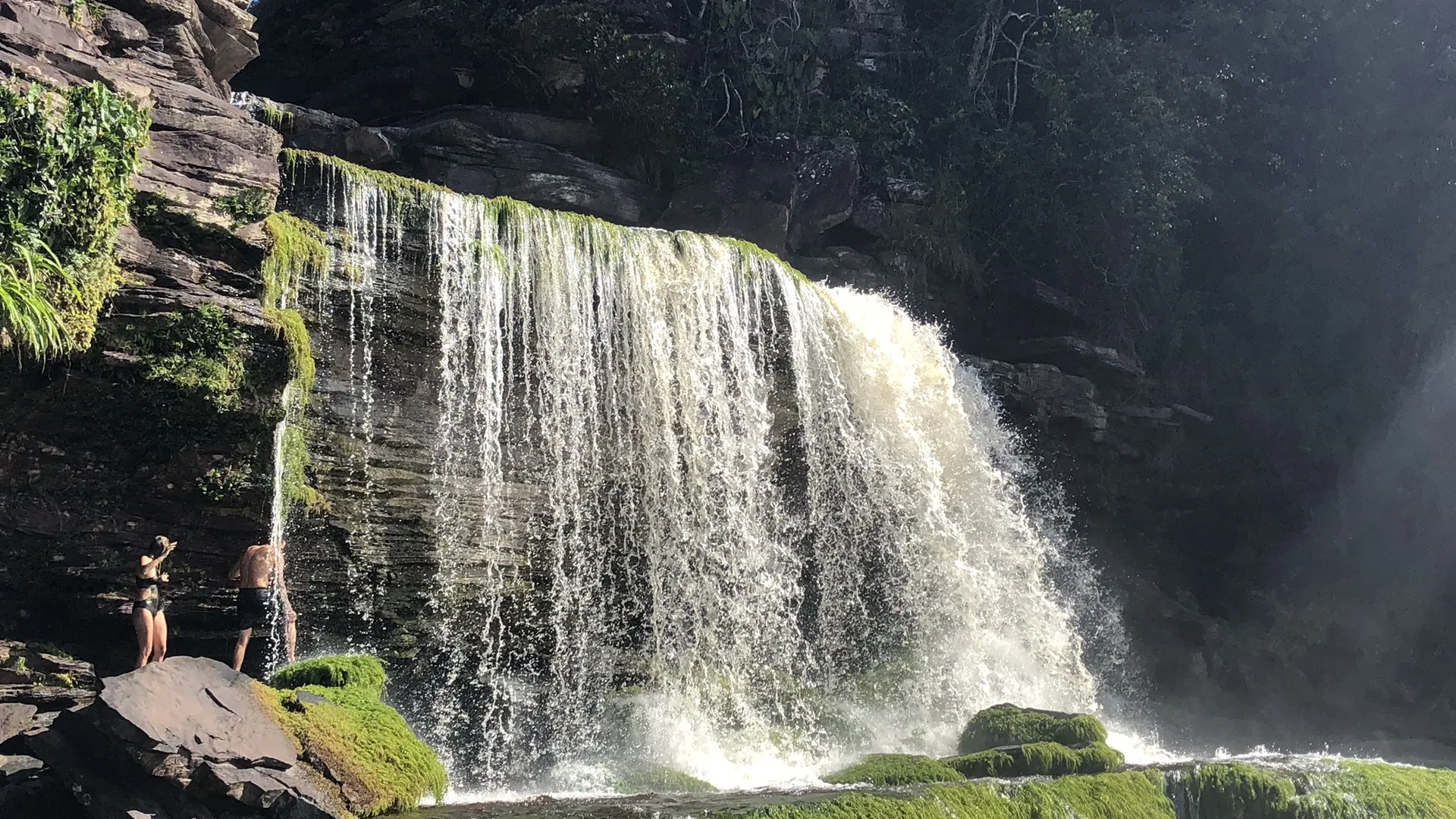
One of a cluster of wide waterfalls spilling into Laguna de Canaima, framed by sandstone tepuis that rank among the oldest rock formations on Earth. Salto Golondrina shares its lagoon with Salto Hacha, Salto Ucaima and Salto Wadaima, each pouring the tea-colored, tannin-stained waters of the Carrao River over a low escarpment into pink sand and still water.
The Gran Sabana keeps its waterfalls the way it keeps everything else: in plain sight, and almost impossible to reach. Salto Golondrina drops into Laguna de Canaima alongside three siblings — Hacha, Ucaima, Wadaima — each fed by the same Carrao River, each stained the deep amber of tannins leached from the surrounding forest floor. From a distance the four falls look almost identical: wide, unhurried curtains sliding off a low sandstone lip into a lagoon the color of steeped tea, ringed by pink quartz sand.
For most of the year, Golondrina cannot be approached on foot. The lagoon and its falls exist behind a buffer of water and current that only a canoe, or extreme drought, can cross. Visitors watch it from across the lake, from the porches of the Canaima camps, from small boats that thread between the falls but rarely land beside them — a waterfall best appreciated as scenery rather than destination, its plunge visible in full only from the safety of distance.
That inaccessibility is not an accident of tourism infrastructure but a feature of the place itself. Canaima National Park sits at the edge of the Gran Sabana, where the land rises abruptly into tepuis — table mountains of Precambrian sandstone, among the oldest exposed rock on the planet, isolated for so many millions of years that their summits evolved separate ecosystems found nowhere else. Salto Golondrina falls from the outwash of that older world into the newer one, a boundary marker as much as a waterfall.
The four falls of Laguna de Canaima are frequently visited as a set, and it is Angel Falls — the tallest waterfall on Earth, reached by boat further up the Carrao and Churún rivers — that draws most of the attention paid to this stretch of Venezuela. Golondrina is the fall people notice from the beach, in the middle distance, while planning the trip to something taller. It rarely gets its own itinerary. But seen up close from a canoe cutting through the spray, low sun turning the tannin water to bronze and the falling curtain to a wall of light, it becomes clear why the indigenous Pemón people who have lived here for centuries never needed it to be the biggest waterfall in the world. It only needed to be this one.
Safety information
Salto Golondrina is located in the remote Canaima National Park area. Visiting requires serious preparation, local guidance, and current security checks; independent travel is not recommended.
Why this guidance exists
Recommended actions
- Do not visit independently; use a reputable local operator or authorized guide
- Verify current access conditions, local security, park rules, and transport availability before departure
- Avoid swimming, climbing, or walking behind/near the waterfall unless a local guide confirms it is safe
- Stay away from cliff edges, wet rock, strong currents, and waterfall impact zones
- Do not visit during heavy rain, storms, high water, or poor visibility
- Carry waterproof footwear, dry bags, offline maps, drinking water, sun protection, and insect protection
- Prepare for limited mobile signal, difficult evacuation, and limited nearby medical care
- Respect Canaima National Park's protected environment and avoid damaging vegetation, rock surfaces, or riverbanks
- Check official government travel advisories before planning travel to Venezuela
- Have medical evacuation insurance and an emergency communication plan
Sources
- https://travel.state.gov/en/international-travel/travel-advisories/venezuela.html
- https://travel.gc.ca/destinations/venezuela
- https://www.gov.uk/foreign-travel-advice/venezuela
- https://www.gov.uk/foreign-travel-advice/venezuela/safety-and-security
- https://www.nederlandwereldwijd.nl/reisadvies/venezuela
- https://www.auswaertiges-amt.de/de/service/laender/venezuela-node/venezuelasicherheit-224982
- https://www.exteriores.gob.es/es/ServiciosAlCiudadano/Paginas/Detalle-recomendaciones-de-viaje.aspx?trc=Venezuela
- https://whc.unesco.org/en/list/701/