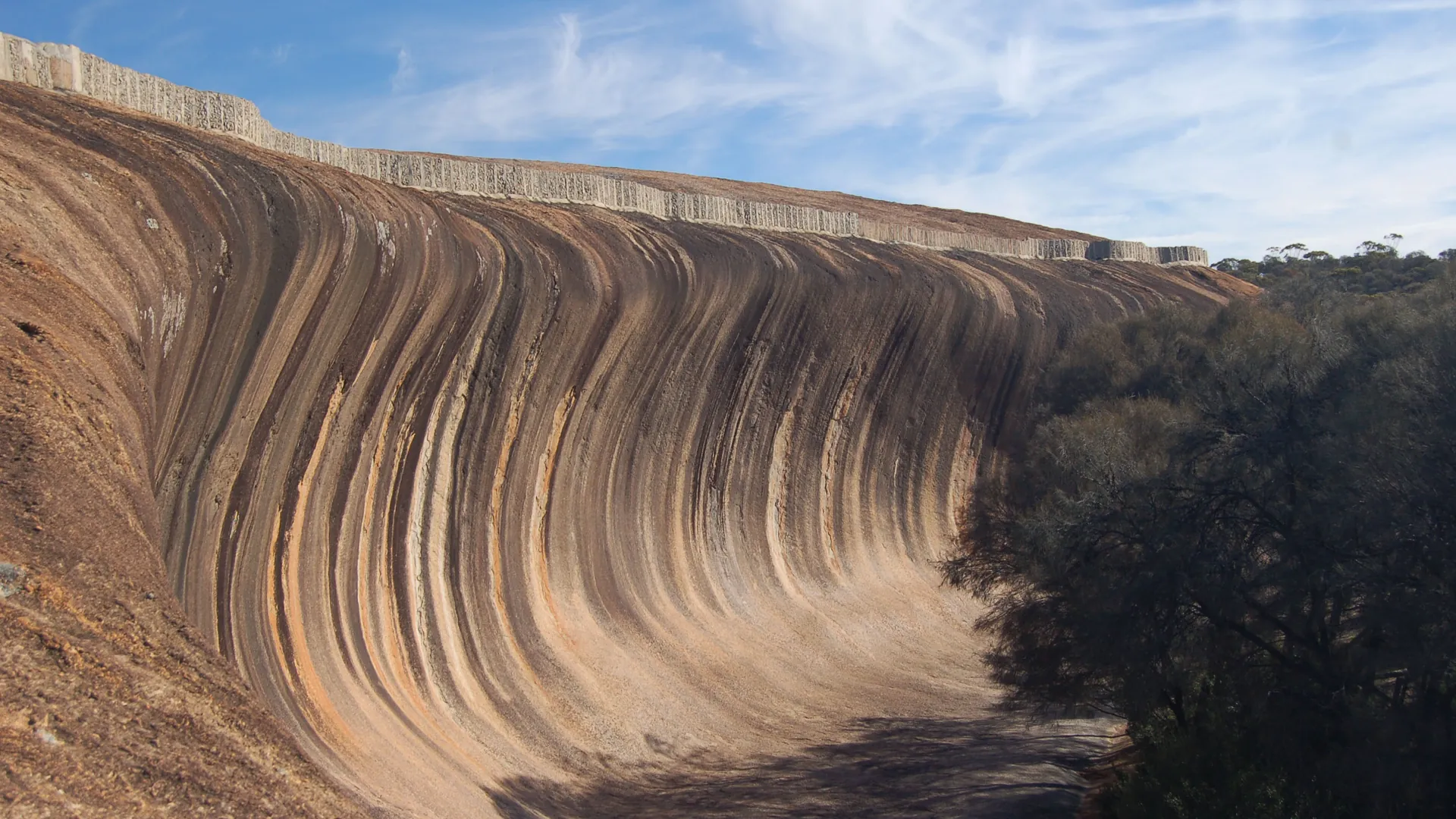
Wave Rock near Hyden in Western Australia is a 15-metre high, 110-metre long granite formation curved like a breaking ocean wave — one of Earth's oldest exposed rock surfaces, its striped face stained by minerals running down the same stone for hundreds of millions of years.
Wave Rock is 2.7 billion years old. This number requires a moment to sit with. The rock that forms it — a type of granite called Hyden Rock — was part of the basement layer of the ancient continent of Gondwana before Gondwana broke apart. It was old before the first animal with a skeleton appeared on Earth. It was old before the oceans assumed their current salinity. The wave-shaped overhang at its base is younger — perhaps 60 million years old, carved by the weathering of rock beneath a soil layer that has since eroded away — but the rock itself predates almost everything.
The wave shape is the result of cavernous weathering. Water percolating through the surrounding soil came into contact with the granite's surface and dissolved the minerals along the rock face, cutting it back progressively over tens of millions of years. When the soil eroded away, the concave face was exposed: 15 metres high, 110 metres long, curving inward from the base in a form that bears an unmistakable resemblance to a breaking ocean wave. The timing of the moment — a wave caught in its curl — is geological accident. The resemblance is exact.
The striped face of Wave Rock — horizontal bands of grey, red, ochre, and cream running across the curved surface — is produced by mineral-laden water running down the granite over millennia, depositing different compounds at different rates. The bands are not painted or arranged; they are the accumulated record of water movement across the same rock face across geological time.
Wave Rock sits near Hyden in the Western Australian wheatbelt, a landscape of flat agricultural land interrupted by occasional granite outcrops. The surrounding terrain gives the formation no visual preparation: you drive through flat wheat fields, and then the rock is simply there, 15 metres high, wave-shaped, ancient, in a paddock. The shock of the encounter is partly the form and partly the context — the complete absence of any landscape feature that would predict it.
Safety information
Wave Rock is generally open to visitors, but the granite surface can be slippery or exposed, and the area can be hot, remote, and affected by weather or emergency alerts.
Why this guidance exists
Recommended actions
- Stay on established paths and follow all posted signs
- Avoid climbing onto wet, slippery, or exposed granite surfaces
- Keep away from edges and steep sections, especially in wind or rain
- Wear sturdy footwear with good grip
- Carry drinking water, sun protection, and a hat, especially in warm weather
- Avoid visiting during extreme heat, thunderstorms, high winds, bushfire risk, or poor visibility
- Watch for snakes and other wildlife; do not approach or disturb animals
- Supervise children closely near rock edges and uneven surfaces
- Check Emergency WA and DBCA alerts for road, park, fire, or closure information before travelling
- Respect Aboriginal cultural sites and do not touch, mark, climb on, or damage rock art or natural formations
- Plan fuel, food, and return travel in advance because the location is several hours from Perth
- Pack out all rubbish and avoid damaging vegetation or granite surfaces