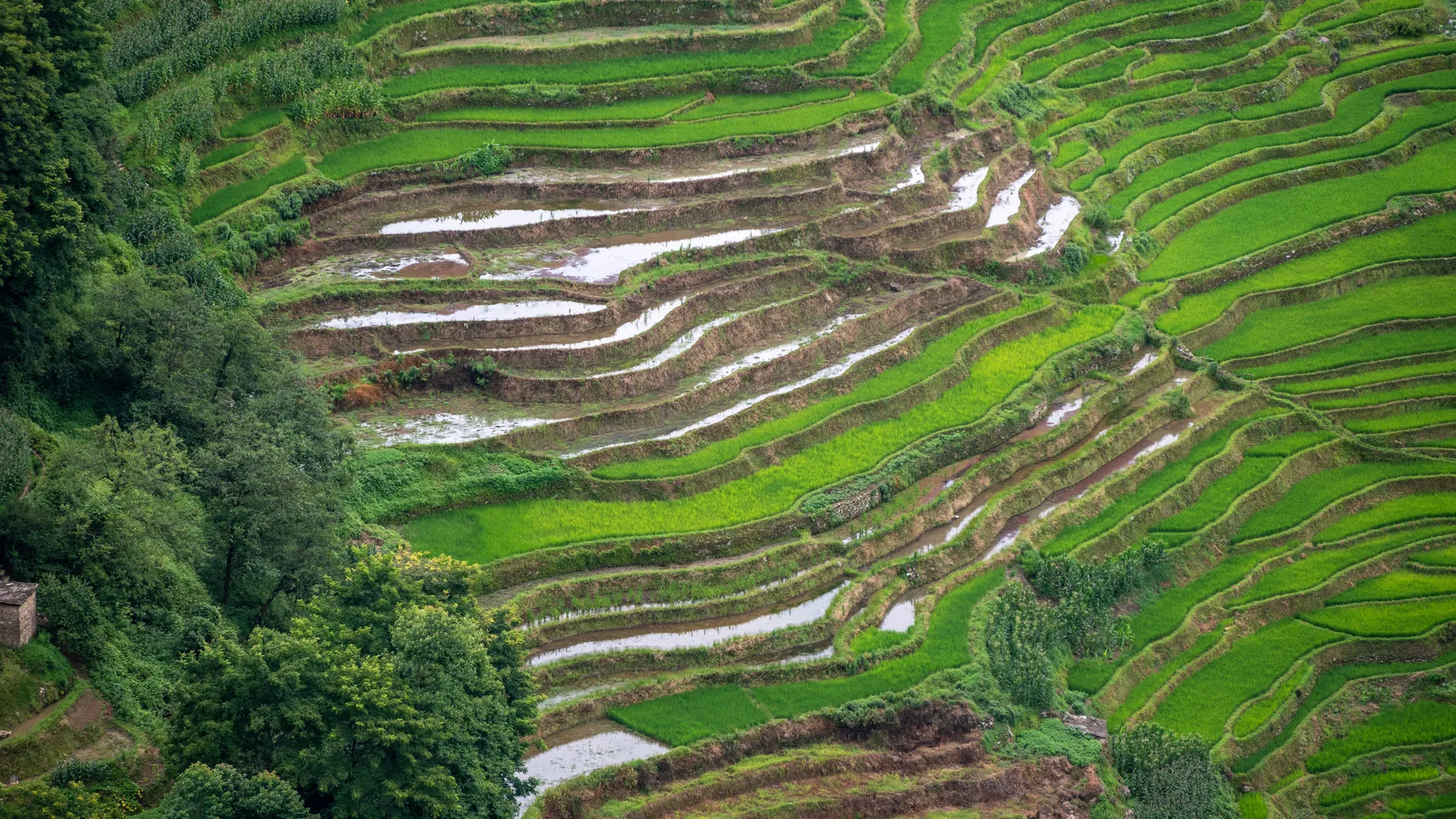
The Hani people of Yunnan province have been cutting rice terraces into the mountains above the Red River for 2,300 years, creating a landscape of flooded fields that reflect the sky from altitude — one of the largest and most complex human-made landscapes still actively farmed on Earth.
The Hani people have been cutting rice terraces into the mountains of Yunnan for approximately 2,300 years. The terraces extend across four counties around Yuanyang, stepping down the mountain slopes in curved arcs that follow the contours precisely, each terrace level and flooded, each one reflecting whatever sky is above it. The landscape they have created is one of the most complex agricultural systems ever built by hand.
The terraces work with the mountain hydrology rather than against it. The Hani village system is built in the forest above the fields — the forest generates rainfall and feeds springs that flow down through the villages, where water is used for cooking and drinking, then through the terraces below, where it irrigates the rice, then into the valley floor. A single watershed supports multiple villages and multiple terrace systems. The water cycle from forest canopy to paddy field has maintained this balance for over two thousand years.
During the flooded season — roughly November through April, when the terraces are prepared but not yet planted — the fields become mirrors. At altitude, the air is often clear enough that the sky and clouds reflect precisely in the still water, producing an effect where it becomes difficult to orient the landscape: the sky appears below, the clouds below the mountains, the reflections more vivid than the objects they reflect. The photographs taken from the viewing areas above Duoyishu and Bada Terrace in the early morning, when mist fills the valley below the terrace level, are among the most reproduced landscape photographs in Chinese photography.
The terraces are still actively farmed. The Hani people live in the same villages, maintain the same irrigation channels, flood and drain the same terraces. The landscape is not a heritage site preserved in amber — it is a working agricultural system that happens to be 2,300 years old, still doing what it was built to do.
Safety information
Yuanyang Rice Terraces are open to visitors, but access may depend on scenic-area tickets, local rules, weather, road conditions, and protection requirements for the UNESCO cultural landscape.
Why this guidance exists
Recommended actions
- Check current scenic-area tickets, opening hours, viewpoint access, and transport options before visiting
- Use established viewpoints, paths, and roads instead of walking across planted terraces
- Do not step on rice fields, irrigation channels, terrace walls, or private farmland
- Wear sturdy shoes with good grip, especially after rain or in early morning mist
- Avoid walking near terrace edges in fog, darkness, rain, or slippery conditions
- Use a local driver or guide if unfamiliar with mountain roads and village access rules
- Allow extra travel time because mountain roads can be narrow, winding, and slow
- Bring warm layers, rain protection, water, and offline maps
- Respect Hani villages, local customs, homes, sacred spaces, and photography restrictions
- Avoid blocking roads or paths with tripods, vehicles, or photography equipment
- Do not fly drones unless clearly permitted by local rules
- Pack out all trash and avoid damaging the UNESCO-protected cultural landscape
Sources
- https://whc.unesco.org/en/list/1111/
- https://www.visityunnanchina.com/plan-your-trip/travel-blog/yuanyang-rice-terraces-living-masterpiece-earth-and-sky
- https://www.trip.com/t/BjR7gGcaPV2
- https://www.yunnanexploration.com/attractions/yuanyang-hani-rice-terraces-honghe
- https://visit-yunnan.com/en/destinations/yuanyang