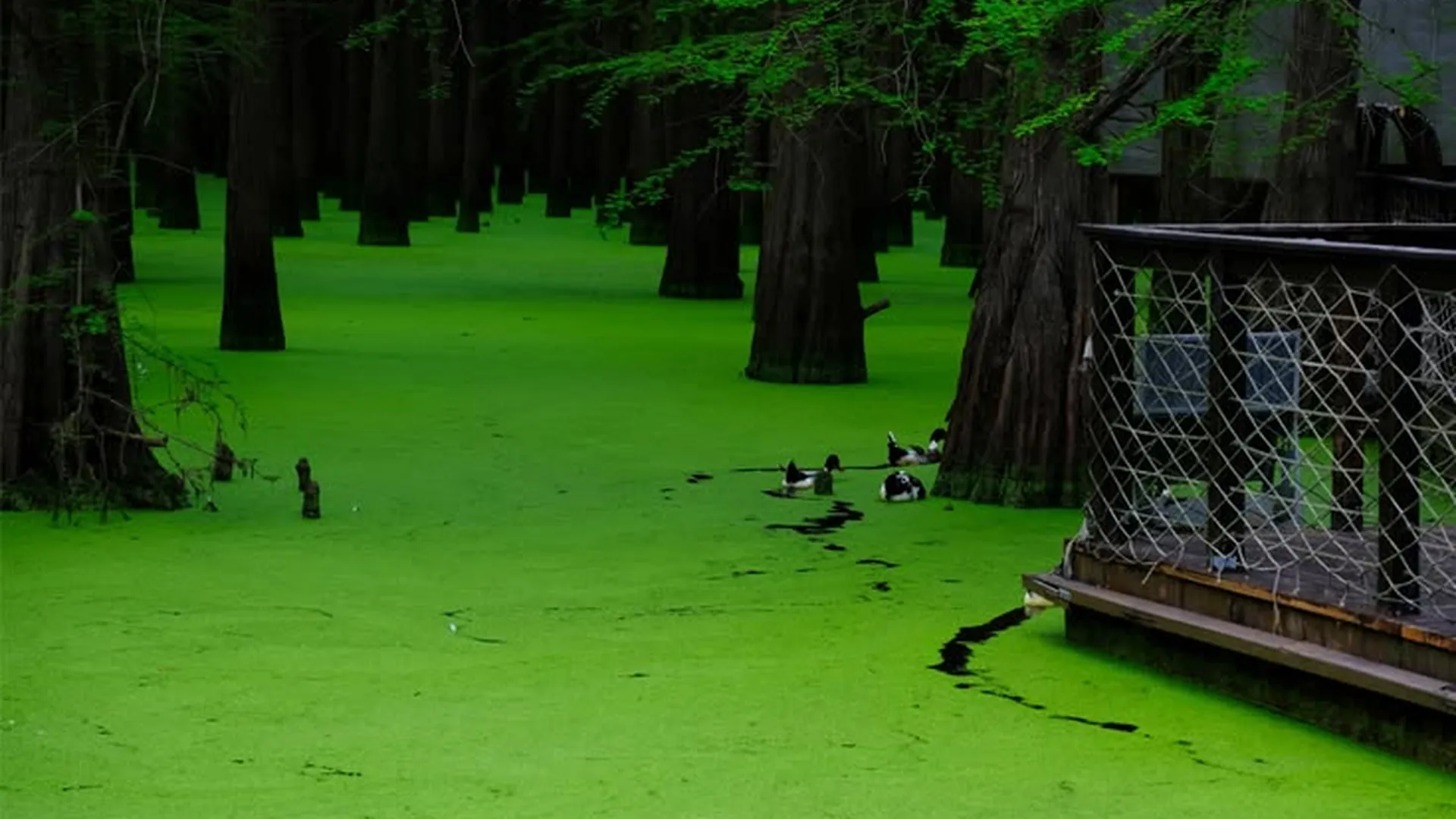
A reservoir in Zhejiang where a forest of Amazonian pond cypress trees rises straight out of the lake, their roots submerged in water so thick with duckweed it turns the color of matcha. Thousands of trunks form corridors between water and sky, a landscape planted by accident in the 1960s and only now revealing what it was becoming.
In 1964, engineers dammed a valley west of Hangzhou and called the result Qingshan Lake — a reservoir, nothing more, built to hold water for a growing region. Someone, for reasons lost to the decades since, planted a batch of pond cypress saplings along its northern shallows: a species native to the swamps of the American South and the Amazon basin, chosen perhaps for its tolerance of wet feet, perhaps by accident of nursery stock. No one expected the trees to become the reason people come.
Sixty years on, the pond cypresses have grown into a forest that stands directly in the lake, a million square meters of trunks rising from water that never fully recedes. Their root systems, adapted over millennia to swampland an ocean away, found the reservoir's shallows to be exactly the kind of half-drowned home they were built for. The trees did not just survive the flooding — they came to define the place.
Each spring and summer, the water beneath the cypress grove fills with duckweed, a floating plant that multiplies until the entire surface turns a saturated, uniform green — the shade of ceremonial matcha, locals say, thick enough that the water appears solid. Kayaks push soft furrows through it. Herons and white storks pick their way along the tree line. The effect, from a low boat between the trunks, is of paddling through a forest that has simply decided to grow inside a lake instead of beside one.
What makes Qingshan Lake strange rather than merely pretty is the accident at its center: nothing here was designed to look like this. The dam was infrastructure. The trees were a minor planting decision. The color is algae. And yet the combination produces something that reads, in photographs, as deliberately surreal — a forest suspended in green glass, corridors of bark and light that seem staged for a film rather than grown by a reservoir crew doing their jobs six decades ago.
Beyond the water forest, the lake is ringed by more than two hundred peaks, the tallest offering views back down over the matcha-colored shallows and the paler open water beyond. Deer move through the surrounding hills, storks nest in the cypress crowns, and in autumn the green gives way to reflections of the turning forest above — a second, temporary transformation layered onto the first.
Safety information
Qingshan Lake is generally open to visitors, but access may depend on scenic area hours, ticketed zones, boat/kayak rules, and weather conditions.
Why this guidance exists
Recommended actions
- Verify the exact scenic area entrance, opening hours, ticket requirements, and last-entry time before visiting
- Use only official boardwalks, paths, piers, boats, and kayak operators
- Do not swim or enter the lake unless explicitly permitted by the scenic area
- Wear suitable footwear, especially after rain or when walking on wet boardwalks
- Use a life jacket for boating, kayaking, or any water activity
- Avoid visiting during thunderstorms, heavy rain, strong wind, or poor visibility
- Supervise children closely near the water, boardwalk edges, and piers
- Do not damage trees, duckweed, wetland vegetation, or the water forest ecosystem
- Expect crowds and limited parking during weekends, holidays, and autumn foliage season
- Check local transport and return options in advance, especially if relying on public transit